My Seoul Story Entering Korea's mosh pits
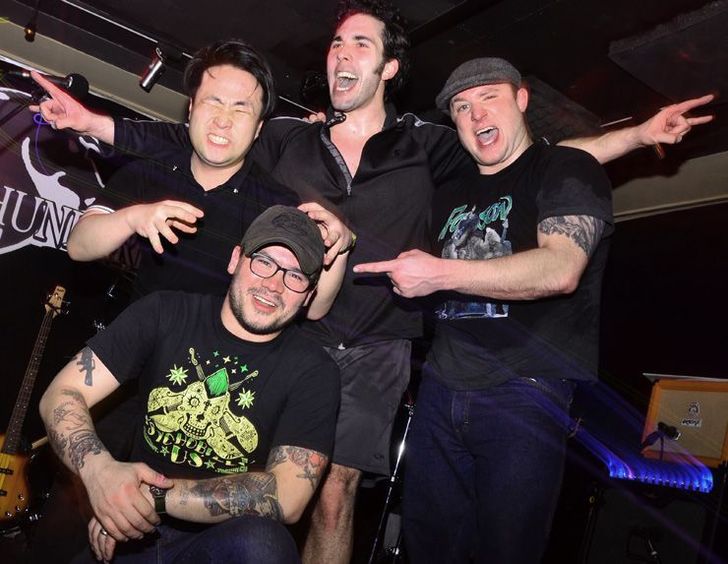
Members of Korean-American punk band Heimlich County Gun Club pose on stage at Thunderhorse Tavern in Seoul. / Courtesy of Jon Dunbar
This is the second in a series of contributions about Seoul’s charms as seen from foreigners’ points of view ― ED.
By Jon Dunbar
Live music is one of the basic needs, along with food, clothing, shelter and alcohol. So when I moved to Korea in December 2003, I scoured the internet for traces of Seoul's live music scene.
Jon Dunbar
Back then, there wasn't much information. I knew of Club Drug, the cornerstone of the 1990s Korean punk scene, through reputation, but had no accurate data. My first weekend there, I found Drug in Sangsu-dong near Hongik University, stumbling down the pitch-black stairwell with no railing, led only by the sound of muffled live music until I opened the door. But the people there were only practicing and didn't know when the next show was.
I found an English page for Skunk Label, which led to a punk show in Sillim, southern Seoul, at Turn Live Hall, probably long since vanished. But the directions were wrong. I wandered the alleys of Sillim, ready to give up, until I came across a ripped handbill on the ground that finally led me there. I arrived in time to see the last band play their final song.
Once I made contact, I quickly got to know everyone in the scene. It was good to be among likeminded music fanatics, despite language differences. We found that we really weren’t all that different after all. Being around Korean punks was just like being at home.
Over the years, I’ve met a lot of other foreigners coming to shows, some who tracked us down, some who stumbled across our scene by luck. Many faced challenges, as they didn’t know where to look, where to get the information, or even to look at all. I got used to newcomers saying, "I've been here for 11 months and I didn't know this existed! I'm leaving next month. This scene would have made my limited time here better."
These days, Seoul's underground music community is better known, famously located in the Hongdae area. Finding it is another matter, as Hongdae has turned into a sensory overload of lights, sounds and large crowds. Finding concerts isn't as simple as wandering around finding live music venues: bands don’t always play the same venue, and venues rent out to different promoters. Gentrification forced the music scene underground and into other neighborhoods, such as Club SHARP in Mangwon-dong and GBN Live House down south in Mullae-dong.
It takes research, but it's rewarding, even if you're visiting for just a weekend. Many online resources in multiple languages exist to help anyone find concerts, websites like DoIndie and KoreaGigGuide as well as numerous Facebook pages and groups. I help run the Korean Punk and Hardcore page, where we push out weekly concert listings for punk, hardcore, ska, rockabilly, etc. All it takes is searching keywords.
Every weekend, Seoul has dozens of shows, where underrated indie bands of various genres play their hearts out to not enough people. These days, anyone can find bands they like, go to their shows and hang out with them until the first subway the next morning. Seoul has become a fulfilling destination for live music lovers looking for something different, whether they’re staying a weekend, a year, or longer. The same can't be said for K-pop fans, who come here only to find the K-pop industry hopelessly impermeable.
It is ironic that punks and other counterculture folk ― people who are considered freaks in their home countries ― come here and are welcomed by an increasingly international network of kindred spirits, while other “normal people” are left to discover ― many for the first time in their lives ― what it feels like to be the misfit.
Jon Dunbar is a copy editor at The Korea Times.