‘Even small lives matter’: Students lead effort to rescue worms drying on asphalt
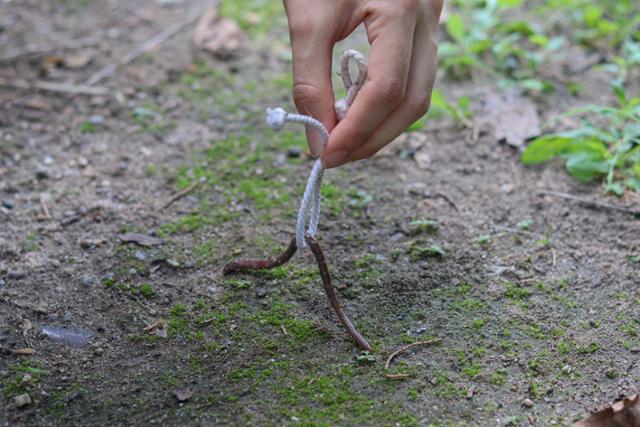
A Hongik University student carefully rescues an earthworm using a thin rope. Courtesy of Kim Hee-su
In the heart of Seoul, a growing movement is working to save some of the planet’s smallest — yet most vital — creatures: earthworms.
At Hongik University’s campus in Mapo District, students have set up a “worm shelter” and two rescue tool stations to protect earthworms that struggle to survive after heavy rains or extreme heat.
The project, called “Jigu-dae” — short for “Operation Save the Worms” in Korean — was launched by five seniors in the university’s wooden furniture design department. The shelter, made from recycled wood, contains fertile soil and leaves to create a safe temporary refuge for rescued worms, even featuring a drainage system.
Saving lives, one worm at a time
The rescue kits include small plastic spoons, forks and thin ropes to gently lift worms off hot asphalt. In the absence of tools, rescuers can improvise with leaves, twigs or business cards. Passersby who spot worms in danger can move them to the shelter, and after the rain stops, student volunteers release them into shaded flower beds or healthy soil.
Park Ji-han, one of the student organizers, said the project began with a simple idea. “I imagined someone rescuing a worm and placing it in a shelter. Knowing we’ve actually saved many of them makes me proud.”
At first, many volunteers found earthworms unpleasant to handle. But over time, some grew fond of the creatures. “I was scared of worms at first,” said fellow student Park Ji-yoon. “But as I learned more about them, I became comfortable. If you approach them gently, they feel less intimidating.”
Left, illustrator Kim Ji-won shares composting worms she has carefully raised with workshop participants, while a close-up on the right shows the worms prepared for adoption. Hankook Ilbo
Community joins the effort
The movement has since expanded beyond campus. In early August, more than 10 volunteers gathered in Seoul’s Eunpyeong District to share worm rescue experiences during a workshop organized by the Korean Federation for Environmental Movements (KFEM).
Sixty volunteers have formed an online group called “Worm Dreamers” to exchange tips on rescue techniques and tool usage. Illustrator Kim Ji-won, who raises composting worms at home, led a session on worm behavior and care, offering attendees some of her 1,000 home-raised worms to take home.
A dried earthworm found on the roadside after intense heat and rain / Hankook Ilbo
Kim explained that composting worms are different from those found on sidewalks. Starting with just 20 worms, she has now bred more than 1,000. They feed on watermelon rinds, melon peels, eggshells, cardboard and even newspaper scraps. Their nutrient-rich castings are used to grow basil and tomatoes, completing a small-scale cycle of sustainable farming.
Worm rescue tool kits installed by Hongik University students / Courtesy of Kim Hee-su
Earthworms are often seen on roads and sidewalks after rainfall. While many assume they surface to avoid drowning, scientific research suggests other explanations. According to Scientific American, worms can survive underwater, but the vibrations caused by falling rain may mimic those of predators like moles, prompting worms to escape upward.
Professor Hong Yong of Chonbuk National University said earthworms also surface to migrate long distances and disperse their populations during wet weather, preventing overcrowding. However, he noted that outcomes vary depending on temperature, soil conditions and species traits.
Unfortunately, many worms that surface become stranded on sun-scorched concrete or asphalt, where they dry out and die. “Some wander at night and fail to find their way back before sunrise,” Hong said. “If they can’t return to the soil before their skin dries out, they perish.”
'The most important workers on Earth'
Charles Darwin’s final book, “The Formation of Vegetable Mould Through the Action of Worms,” highlighted the crucial role of earthworms in nature. Hankook Ilbo file
Earthworms are critical to healthy ecosystems. British biologist Charles Darwin famously wrote in his final book, “The Formation of Vegetable Mould Through the Action of Worms,” that he doubted there has ever been an animal more important in the history of the world.
Their castings enrich soil with nutrients, improve plant growth and create tunnels that allow air and water to circulate underground, supporting microbial diversity. But experts warn that rapid urbanization, pesticide use and soil contamination have caused a significant decline in worm populations.
A cluster of earthworms found dead on the pavement after exposure to extreme heat / Hankook Ilbo
A volunteer rescues an earthworm by using a plastic fork to move it safely to shaded soil. Courtesy of Kim Hee-su
“Helping a worm back to shaded soil can save its life,” said Choi Hyun-gi, a researcher at the National Institute of Biological Resources. “But ultimately, reducing pesticide and plastic use and restoring soil health are essential to protecting their ecosystems.”
Professor Hong added, “Earthworms shouldn’t be dismissed as insignificant creatures. They are silent workers supporting life on this planet, and they deserve our attention and care.”
This article from the Hankook Ilbo, the sister publication of The Korea Times, is translated by a generative AI system and edited by The Korea Times.