‘What if we all died at 50?’: Climate crisis imagined in opening film of Seoul environmental festival
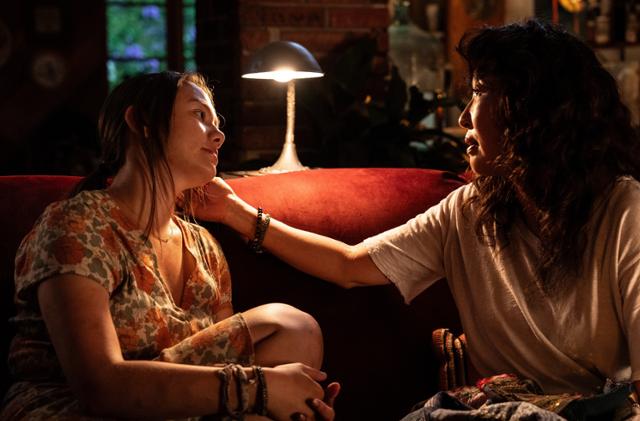
A scene from "Can I Get a Witness?" / Courtesy of Korea Green Foundation
What if the price of saving the planet was dying at 50?
This provocative question sets the stage for "Can I Get a Witness?" — the opening film of the 22nd Seoul International Eco Film Festival — which began on June 5 to mark World Environment Day.
The film paints a vision of a near future where there are no cars on the road, no refrigerators in homes, and no smartphones documenting major life moments — just hand-drawn sketches lit by a single lamp after sundown. It may resemble the past before the Industrial Revolution, but it is, in fact, a society that has deliberately chosen an analog lifestyle to ensure Earth’s survival.
In this imagined world, humanity has abandoned the era of “infinite production and infinite consumption,” once defined by reckless carbon emissions. Instead, people lead frugal but contented lives. Poverty and inequality have been eliminated, ecosystems flourish, and nature is stunningly beautiful. And yet, the film’s utopia is built on a haunting premise: all humans die at age 50 under a global constitution designed to prevent resource depletion and mass extinction.
The story follows Kiah (played by Keira Jang), a gifted illustrator who starts her first job as a “documentarian” drawing people’s final moments. Her mother Ellie (Sandra Oh), nearing her 50th birthday, calmly begins preparing for her death.
Director Ann Marie Fleming, who visited Korea for the festival, said the film is a fantasy designed to provoke and raise awareness of the climate crisis. She added that she thought it would be a bold twist to suggest that people die at 50, a time when most are still struggling to build their lives. Notably, the year 2025 in the film marks a turning point in human history — triggered by mega wildfires and floods.
Speaking at the opening ceremony held at Yonsei University’s main auditorium in Seoul, Choi Yul, chairman of the Korea Green Foundation, emphasized the power of cinema. “I’ve been an environmental activist for 45 years, but I believe movies change the world faster than anything else,” he said. “People take action more quickly when they are moved by film.”
The Seoul International Eco Film Festival runs through June 30, featuring 77 films and documentaries tackling topics such as wildfires, plastic waste, food, climate change, and animal rights. All films are available for free online. Viewers can register on the official website (https://sieff.kr/) and watch via the “My Page” section, with up to 200 viewers allowed per film on a first-come, first-served basis. Online screenings are available through June 15.
This article from the Hankook Ilbo, the sister publication of The Korea Times, is translated by a generative AI system and edited by The Korea Times.