Police push for farmer's autopsy
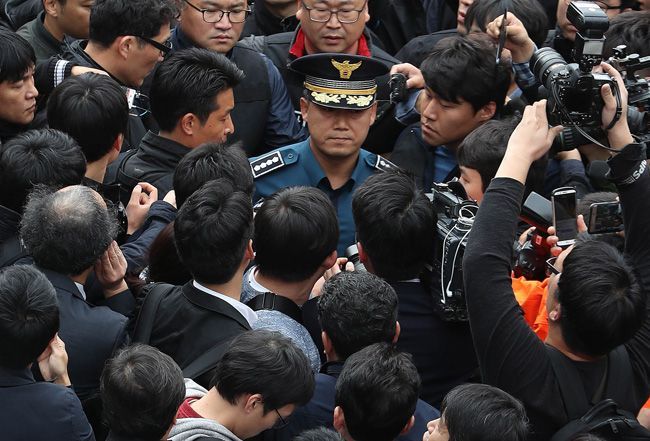
Jongno Police Station Chief Hong Wan-seon is surrounded by reporters and protestors at the entrance to Seoul National University Hospital, Sunday, during a police attempt to execute a warrant to conduct an autopsy on Baek Nam-ki, a farmer who died last month following 10 months in a coma after being hit by a police water cannon. Police withdrew three hours later following strong resistance from the bereaved family and protestors. / Yonhap
Conflict to reach peak Tuesday when warrant expires
By Lee Kyung-min
Police attempted Sunday to forcibly execute a warrant for the autopsy on Baek Nam-ki, a farmer who died last month following a 10-month coma after being knocked over by a police water cannon, but withdrew due to strong resistance from the bereaved family and civic group members.
Conflict over the autopsy is expected to escalate until Tuesday when the warrant expires. Police have argued that they need an autopsy to determine the exact cause of death, while bereaved family say an external shock caused by the water cannon was the direct cause of his death.
With about 800 officers dispatched, police began their action after notifying the family of the execution of the warrant at 9 a.m. They arrived near the entrance to Seoul National University Hospital (SNUH), where Baek’s memorial altar has been set up, at 10:10 a.m., but failed to enter the premises after being blocked by a barricade formed by hundreds of protestors.
Among them were Baek’s family, civic group members supporting the family, and opposition lawmakers including Reps. Park Joo-min and Jung Jae-ho of the main opposition Democratic Party of Korea, and Reps. Sim Sang-jung and Yun So-ha of the minor opposition Justice Party. No major clashes were reported.
Following a three-hour standoff, police decided to withdraw.
“We decided to honor the bereaved family members’ opposition after our attempt to talk with them failed,“ Jongno Police Station chief Hong Wan-seon told reporters at the hospital.
“Although we could not talk directly with the family members, we became aware of their position through media reports,” he added.
When asked whether police will attempt to execute the warrant again, Hong said he would have further discussions.
Bereaved family members have expressed clear opposition to both the autopsy and negotiations with police.
“Police keep demanding that they talk to us. I don’t want to meet police, who killed my father and are preventing us from carrying out the funeral due to their absurd need for an autopsy,” Baek’s daughter, Baek Doraji, said. “We will never meet with the police. They can deliver any message through our legal representatives.”
Police say an autopsy will determine the exact cause of death, while family members maintain their distrust of the authorities, saying this is a mere tactic to divert the cause of his death to something else rather than the water cannon, allowing police and the Park Geun-hye administration to avoid responsibility for his death.
“My father’s death clearly resulted from being shot by the water cannon. We refuse to have an autopsy because the cause of death is certain and evidence is substantial,” Baek’s daughter said.
According to the warrant issued by the Seoul Central District Court on Sept. 28, the authorities are required to negotiate with bereaved family members on how to conduct the autopsy including where to do it and how many people will attend the procedure.
Hundreds of supporters including civic activists and labor union members gathered Saturday near Gwanghwamun Square, downtown Seoul, demanding that government apologize for Baek’s death.