Korea, 6 Central American countries to speed up FTA talks
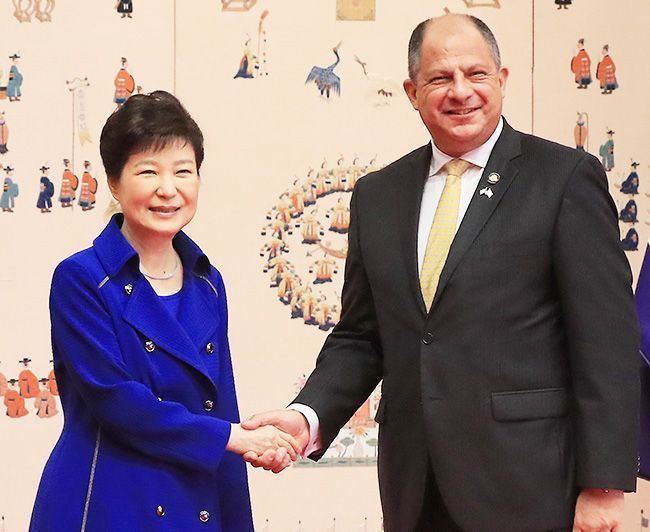
President Park Geun-hye and her Costa Rican counterpart Luis Guillermo Solis shake hands ahead of their summit at Cheong Wa Dae, Wednesday. / Joint press corps
By Kang Seung-woo
President Park Geun-hye and her Costa Rican counterpart Luis Guillermo Solis agreed Wednesday to accelerate their efforts for an early conclusion of free trade talks between Korea and six Central American countries.
The agreement was made during a summit between Park and Solis at Cheong Wa Dae. Solis is on a four-day official trip to Korea.
The six nations are El Salvador, Panama, Guatemala, Honduras, Nicaragua and Costa Rica. The two sides have held six rounds of talks over the free trade agreement (FTA) since June last year.
“Through this summit, the two heads of state shared the view on the need to speed up the free trade talks,” the presidential office said in a statement.
“If signed, Korea is expected to occupy the Central American market in the automobile, steel and machinery sectors against competitors China and Japan.”
The six countries’ combined gross domestic product was $224.7 billion (252 trillion won) in 2015, and they have a combined population of 44.2 million, according to government data.
Korea’s trade with the six Central American countries reached $4 billion last year as Seoul exported cars, synthetic resins and imported coffee, sugar and fruit.
Korea and Costa Rica also agreed to boost bilateral cooperation in developing nfrastructure.
Cheong Wa Dae hopes the agreement will help Korean companies to participate in the Central American country’s large-scale road construction project and its $160 million plan to build a power plant outside its capital San Jose.
On the margins of the summit, the two nations signed seven memoranda of understanding (MOUs), three of which aim to bolster bilateral trade and investment.
In addition, one MOU is about the exchange of tax information, which the presidential office believes will help lay the groundwork for bilateral efforts to prevent offshore tax evasion.