City gov't preserves vestiges of factory workers
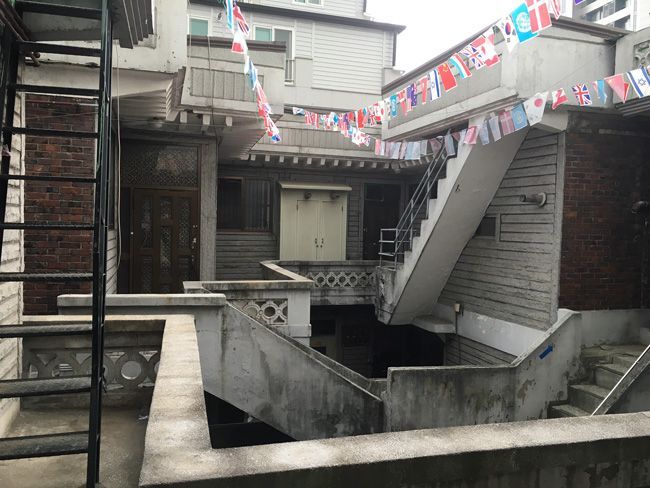
The structures are “beehive homes,” two- to three-story buildings of tiny 10 square-meter rooms and shared bathrooms that were used by factory workers in Garibong-dong near the now-defunct Guro Industrial Complex. Up to five people shared one room due to high rental costs. The Seoul Metropolitan Government purchased two such buildings as part of a development project. / Korea Times photo by Kim Bo-eun
By Kim Bo-eun
Garibong-dong in southwestern Seoul is known as a low-income neighborhood for Chinese immigrants, but bears within it the lives of workers who contributed to Korea’s economic development in the 1970s and ‘80s.
The Seoul Metropolitan Government’s project to develop the area is shining light on the “beehive homes” that housed factory workers of Guro Industrial Complex at the time.
Construction of ‘beehive homes’
As Guro Industrial Complex was set up in the late 1960s and early 1970s, young people from across the nation swarmed to the area with hopes of escaping the poverty of rural life, making money and settling down in the city.
Around 90 percent of the people were young women, aged 15 to 24, who came to work at labor-intensive sewing or wig factories in the complex.
According to data from the Seoul Museum of History, there was a dire housing shortage as the government established the industrial complex without planning for workers’ housing, which prompted the growth of private-sector rental homes.
The government’s approval of the construction of multi-household homes in 1984 spurred the growth of “beehive homes.”
The two- to three-story buildings of tiny rooms and shared bathrooms housed as many as 50 households ― earning its name. About five people used one room, which was about 10 square meters in size.
Due to the costly rents, which were barely covered by their monthly wages, many workers shared the small rooms and adjusted their working hours so that half would work in the day and the other half at night to avoid having to sleep together in the cramped space, according to news articles from the vernacular daily Dong-A Ilbo.
Data from the Seoul Museum of History shows a worker in her third year of employment would receive around 59,000 won in monthly wages and the monthly rent for a room was 50,000 won.
The dire circumstances drove the workers out of their homes to spend their leisure time at bars, discos and billiard halls in the neighborhood, an article from the Hankyoreh said.
Demographic changes
As factories started leaving the complex in the early 1990s, workers left the area and demographics began to change. The homes were filled by an influx of Chinese immigrants in the late 1990s following the opening of diplomatic ties between Korea and China in 1992 and hence an immigrant town was created there.
Since 2010, the population of Garibong-dong has been on the decline, but the percentage of Chinese immigrants is on the rise.
Foreign residents accounted for 40.5 percent of Garibong-dong’s population in 2014 and Chinese immigrants accounted for 98.7 percent of them, according to data from the Ministry of the Interior.
Most of the immigrants live in poor housing and work as restaurant employees, housekeepers, cleaners or day-laborers at construction sites.
Development project
The Chinese immigrant town has been left segregated and the area has been tainted by reports of crime. In an attempt to revive the neighborhood, the SMG, local authorities and residents have engaged in a project to develop Garibong-dong.
The project aims at improving the area’s infrastructure as well as tacking segregation and merging residents with those of neighboring Guro Digital Complex. As part of the project, the municipality in April purchased two of the beehive homes, for use as a communal space for residents.
“The city government purchased the beehive homes, an asset of Garibong-dong, in order to conserve them, to remember their historical significance and to develop them into an important future asset,” said Choi Myeong-kuk, a city official in charge of housing.
Currently, an exhibition is ongoing at one of the houses on the development project. It will run until September.