Nation on alert for food poisoning
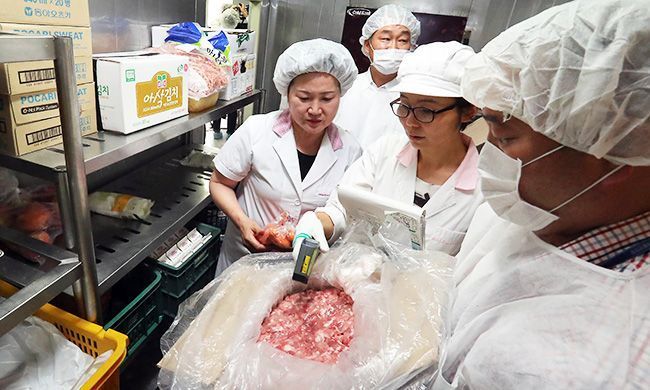
Staffers from food safety authorities inspect ingredients for school meals at Sunjung High School in Eunpyeong, northeastern Seoul, Wednesday, as part of their efforts to prevent food poisoning, as hundreds of students nationwide have suffered from food poisoning after eating at school cafeterias. / Yonhap
Heat wave pushes up food poisoning cases at schools
By Lee Kyung-min
Besides scorching heat in classrooms, students who began their fall semester are facing another challenge — food poisoning.
The humid and hot weather has given rise to food poisoning in hundreds of students who had school meals, prompting the government to launch massive inspections of school cafeterias nationwide.
On Monday alone, a total of 727 high school students at seven schools in Seoul, Busan, North Gyeongsang Province and Daegu showed symptoms of food poisoning including nausea, vomiting, watery diarrhea, stomach pain and fever, according to the Ministry of Food and Drug Safety (MFDS) and the Ministry of Education.
All of the students had been infected with the pathogenic coliform bacillus, a bacterium known to cause the illness, according to stool analysis by health authorities.
The health authority in Daegu said Wednesday that it has temporarily shut down cafeterias in two schools where a combined 124 students showed similar symptoms.
Officials from the two ministries and local governments started inspections of schools that started the fall semester, Wednesday, on food safety, cafeteria sanitation and staff hygiene, five days earlier than their initial schedule.
They checked food storage in school cafeterias and whether the cafeterias used contaminated water in making, pre-cooking, or preserving food.
The ministries said they will set up a new system, under which schools will be able to share information on suppliers of specific ingredients that are believed to have caused food poisoning at one school, so that other schools can avoid them to prevent a further spread of the illness.
The education ministry recommended schools increase monitoring food safety and sanitation, and ask for parents’ participation in this.
However, critics say these measures are basic rules for food hygiene that school cafeterias are supposed to already follow. Some call for a government crackdown and harsh punishment for those failing to follow the safety guidelines.
“The measures are nothing new, and it only focuses on schools’ voluntary efforts, which is not enough to increase safety. Similar incidents will keep occurring unless cafeteria operators or the schools violating the rules face harsher punishment, such as a larger fines,” an official from the Korean Federation of Teachers’ Associations said.
He said the cases at the seven schools could have been prevented if the government had conducted an inspection or raised an alert over possible food poisoning before the schools began the fall semester, adding that it could have predicted that the month-long hot weather would raise the likelihood of this.