Rainbow center reaches out to migrant youths
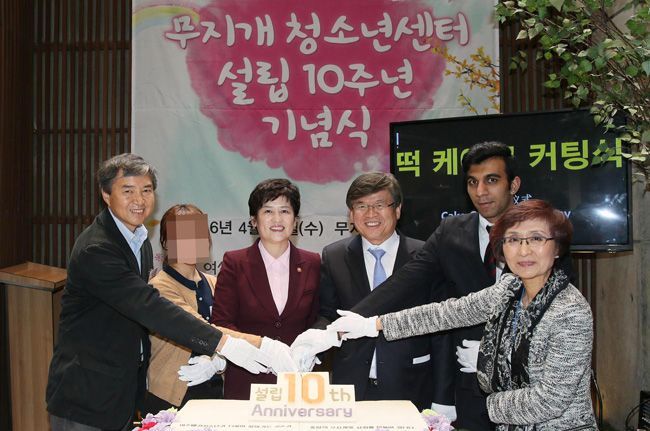
Gender Equality and Family Minister Kang Eun-hee, third from left, cuts a cake with other attendees during the Rainbow Youth Center’s 10-year anniversary ceremony held at the center in downtown Seoul, Wednesday. From left are Chung Byung-ho, first director of the center; a North Korea defector whose identity was withheld; Kang; Kim Kyo-shik, head director of the Migrant Youth Foundation, operator of the center; Sabahat Moon Javaid, a Pakistani who gained help from the center; and Kang Sun-hye, current director of the center. / Courtesy of Ministry of Gender Equality and Family
By Kim Bo-eun
Sabahat Moon Javaid, 23, is perhaps one of the more privileged foreign nationals to enter Korea at a young age.
Having arrived in Korea with his mother and siblings when he was eight, the Pakistani national had less trouble than his older counterparts in learning Korean and adjusting to school life here.
However, Javaid recalls his initial struggles.
“There was a boy in elementary school who bullied me because I looked different. Other classmates also asked me why I spoke in English when I was still learning Korean,” he told The Korea Times.
Javaid’s father came to Korea a year earlier than his family to work at a furniture factory.
The family was able to receive support from a local church, as Javaid’s father started serving as a pastor there. He is currently working at a ministry for fellow Pakistanis at a Korean church in Sindorim, southwestern Seoul.
Javaid was also a beneficiary of the Rainbow Youth Center run by the Migrant Youth Foundation, through which he was able to take part in career development opportunities and also apply for and receive a scholarship during high school.
He gained admission to Kyung Hee University, graduating with a major in hotel management. Javaid currently works at a coffee shop in southern Seoul. He is now a mentor for adolescents at a youth center in Jongno, central Seoul.
“My wish is to become a hotelier ― it is my dream to work as the general manager of the seven-star Burj Al Arab Hotel in Dubai.”
However, circumstances are not so favorable for most of the teenagers who come to the Rainbow Youth Center.
The center, which marks its 10th anniversary this year, has aided some 35,000 adolescents at 23 branches across the country, including North Korean defectors, migrant teens from other countries and multiracial adolescents. Close to 80 percent of them are from China and the remaining 20 percent are mainly from Vietnam, Uzbekistan and the Philippines.
Its role is both to provide direct aid by offering Korean language classes, information and programs, as well as conduct research and put forward proposals for policies on migrant teens. It provides aid to children and young people aged nine to 24.
Most at the center have spent less than a year in Korea, which means their most dire need is to learn Korean in order to transfer into local schools. They receive assistance at the center, but there are cases in which they are unable to attend school due to struggles in learning the language and because their academic abilities fall short of standards.
“In some cases the youngsters are unable to overcome the gap in schooling years which occurs during the transition, and in other cases they have not even received a proper education in their home countries,” said Shin Kuk-kyun, advocacy team chief at the Rainbow Youth Center.
“This is because in most cases, they grow up in tough socioeconomic circumstances. Their parents come to Korea for a better income, which however is limited to low-paying jobs that are shunned by local people.”
It is rare for these youths to enter university. Even if they become employed, the jobs remain limited to part-time positions, Shin said.
However, the center strives to offer the support they need during this critical period of life.
Data from the Ministry of Gender Equality and Family shows there are 200,000 children of 800,000 multiracial families in Korea. There are also some 30,000 North Korean defectors here. The figures continue to grow, but many in need of help remain isolated.
“The thing is, those who have the greatest needs are unable to actively seek help due to language barriers, so they are more likely to be hidden,” Shin said.
“We are working with local authorities as well as Korean Immigration to reach out to youngsters in need of support.”