Park fosters international alliance against NK
President returns from 8-day trip
By Kang Seung-woo
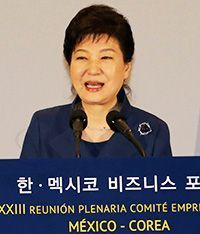
President Park Geun-hye speaks at the Korea-Mexico Business Forum in Mexico City, Tuesday. / Yonhap
President Park Geun-hye successfully helped bolster international commitments to get North Korea to give up its nuclear ambitions during her trip to the United States and Mexico.
Park returned home Wednesday from an eight-day trip that also focused on boosting Korea’s economic partnership with Mexico.
The President held a series of talks with U.S. President Barack Obama, Japanese Prime Minister Shinzo Abe and Chinese President Xi Jinping on the sidelines of the Nuclear Security Summit in Washington, D.C. and the leaders reaffirmed their position against North Korea possessing nuclear weapons.
More specifically, Park, Obama and Abe agreed to thoroughly enforce a new United Nations (U.N.) resolution as well as their own sanctions on North Korea to force the Kim Jong-un regime to abandon its nuclear program.
On March 2, the U.N. unanimously adopted the harshest-ever resolution on the reclusive country for its recent nuclear test and long-range rocket launch.
The leaders also agreed to further enhance their solidarity with the international community to make sure it effectively steps up the pressure on North Korea.
In addition, the Chinese President’s pledge to faithfully implement the sanctions on the North, Beijing’s ally from the Cold War era, in his seventh summit with Park is considered a noteworthy diplomatic achievement.
“The four leaders at the gathering reaffirmed their intentions to implement the sanctions; but it was unusual for President Xi to announce a complete, all-out imposition of the sanctions. This must have been a significant shock to North Korea,” Yun Duk-min, chancellor of the Korea National Diplomatic Academy, said in an interview with KBS, a local broadcaster.
The agreement between the leaders may have extra significance, as the firm attitude may play a role in preventing the North Korean regime from conducting a fifth nuclear test or additional military provocations, projected in late April or early May on the occasion of the seventh Workers’ Party Congress ― the first to be held in 36 years.
However, China’s proposal for peace treaty talks to formally end the Korean War in tandem with its implementation of the U.N. resolution and its firm opposition to the U.S. deployment of the Terminal High Altitude Area Defense (THAAD) on the Korean Peninsula are leaving room to weaken Seoul’s pursuit of a pressure-first North Korea policy.
Another variable is the U.S. and Japan pushing for a trilateral security alliance with South Korea to contain China in the region, which may trigger a backlash from Beijing which could include it eventually withdrawing its commitment to the sanctions.
In Mexico, Park also gained support from Mexican President Enrique Pena Nieto for the U.N. sanctions on the North.
The country detained a North Korean freighter, blacklisted by the U.N. for illegally shipping arms in 2014, and Pena Nieto told Park during their summit, Tuesday, that it will continue to hold on to it despite the North’s protests.
Along with security cooperation, President Park has cleared the ground for the country to expand economic cooperation with Mexico ― the second largest market in Latin America behind Brazil.
The two president agreed to resume working-level talks on a free trade agreement (FTA) in the fourth quarter of the year that Park believes will open a new gateway in Northeast Asia for Mexico, while Korea can expand its access to North, Central and South America. The negotiations have been suspended since 2008 due to strong opposition from the Mexican auto industry.
Also, the two countries signed 34 memoranda of understanding (MOUs) to boost their economic relationship that will help Korean firms participate in infrastructure projects in Mexico, which is starting projects worth $590 billion to modernize the energy, transport and water resources management sectors.
The Mexican President promised to support Korea joining the 12-nation Trans Pacific Partnership (TPP), which will become the world’s single largest trading bloc, if formed, accounting for 40 percent of the world’s gross domestic product.