President's welfare policy still adrift
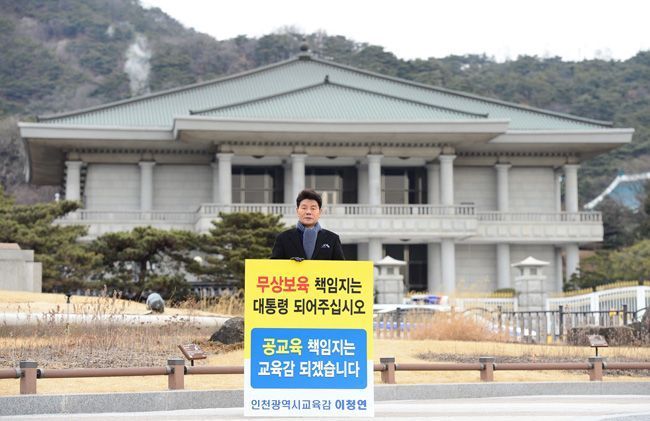
Lee Cheong-yeon, superintendent of Incheon Metropolitan City Office of Education, calls for the central government’s financial responsibility for free preschool programs during a one-man protest in front of Cheong Wa Dae, Seoul, on Feb. 22. / Yonhap
By Chung Ah-young
President Park Geun-hye pledged to expand welfare benefits to the elderly and children “without raising taxes” as part of efforts to tackle the effects of the aging population and the low birthrate.
But entering her fourth year in office, Park faces questions about whether this promise can be kept because most of her welfare policies have been scaled down over the past three years due to lack of finances amid the prolonged economic slump.
In 2013, the first year of her term, Park already scaled back a campaign pledge to pay 200,000 won to all people aged 65 or above, regardless of their income.
Instead, she revised this plan to provide a monthly allowance of between 100,000 and 200,000 won to the poorest 70 percent of senior citizens. Park said the revision was inevitable because the original pledge might have put an excessively heavy burden on future generations.
Another disappointing policy might be the free preschool program at kindergartens and daycare centers. The program, called Nuri Curriculum, has created a budgetary conflict between regional education offices and the central government every year.
In 2013, the government expanded the curriculum to include all children aged three to five from the bottom 70 percent of income groups. It was a part of her pledge to strengthen the nation’s responsibility for early childhood education and care.
But due to the snowballing burden on state coffers, the government ordered regional education offices to be responsible for funding the program from 2015.
Suffering from a lack of finances, the offices have refused to do this, claiming they are not responsible, especially for daycare centers which are under the jurisdiction of the Ministry of Health and Welfare.
As a result, 14 out of 17 education offices nationwide have yet to allot budgets for the program for this year.
The free after-school care program for elementary school students has also run into budget problems.
The program, offered to children of double-income families, was originally designed for underprivileged children, but Park expanded it to all children regardless of their parents’ incomes.
The government set aside 100 billion won in 2014 but earmarked no money for the program in 2015 and this year.
As with the Nuri program, the government claims that local education offices should cover the cost.
Last year, the number of children involved in the after-school program was 239,798.
The government recently decided to expand the after-school programs, starting this year, from first to fourth graders to fifth and sixth graders.
“While the government is pushing ahead with the program, it doesn’t say anything about how to finance it and put it into practice,” said an official at an elementary school in Seoul said.
Jung Chang-lyul, social welfare professor at the College of Public Service at Dankook University, said it was impossible to expand welfare without increasing taxes. He said passing the buck to the regional educational offices was a stopgap measure.
“Conflicts are inevitable if the central government doesn’t gain consensus from regional offices in advance for the budget planning,” Jung said at a recent seminar.
“Given the poor financial situation of the offices, the central government should not transfer the burden of welfare to them.”
Jung Chang-hoon, public administration professor at Inha University, said Park’s pledges ignored the reality that would bring tax revenue shortfalls due to populist policies.
“The government’s policy shows that welfare without raising taxes is an empty word,” he said.