Pyongyang preparing to field mobile ICBMs
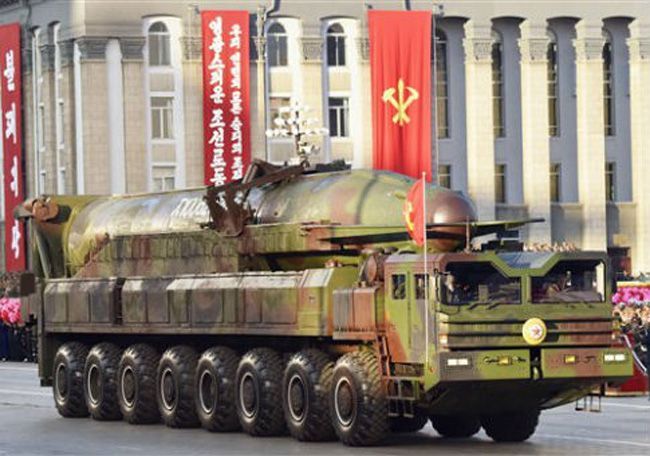
A KN-08 road-mobile intercontinental ballistic missile is paraded in Pyongyang, North Korea during the 70th anniversary celebrations of its ruling party’s creation in this Oct. 10, 2015 file photo. / AP-Yonhap
By Jun Ji-hye
North Korea is preparing to deploy road-mobile intercontinental ballistic missiles (ICBM) believed to have a range of at least 10,000 kilometers, military officials said Sunday.
“The North is believed to be taking steps toward the operational deployment of the ICBMs,” said a military official on condition of anonymity.
The remark came after some media reported, quoting unidentified sources, that the Kim Jong-un regime has formed a new brigade to deploy its KN-08 ICBMs. The reports said the KN-08 Brigade is a subordinate unit of the Strategic Forces, which oversees all missile units in the North.
The official neither confirmed nor denied the report, but he said it is hard to say that the North has formally deployed the ICBMs because it has never conducted a test launch _ an essential step before the operational deployment.
The official indicated that the North seems to have inched closer to fielding the road-mobile ICBMs, but refused to disclose the military’s analysis regarding the timing, citing confidentiality.
A similar analysis was produced last week in the United States.
U.S. Director of National Intelligence James Clapper said Pyongyang “has already taken initial steps toward fielding this (KN-08) system, although the system has not been flight-tested.”
Clapper also stated in his report to the Senate that Pyongyang was committed to developing “a long-range, nuclear-armed missile that is capable of posing a direct threat” to the U.S.
The KN-08 was first unveiled in a military parade in April 2012 during celebrations of the 100th birthday of North Korea founder Kim Il-sung, grandfather of current leader Kim Jong-un.
In its annual report to Congress, the Pentagon stated Friday that if the KN-08 is properly designed and developed, it could be difficult to track because of its mobility.
The North is believed to be developing its abilities to build a nuclear weapon small enough to fit on its KN-08 ICBMs to hit the U.S. mainland.
On Feb. 7, Pyongyang launched what it claims is an Earth observation satellite called “Kwangmyongsong-4,” which is widely regarded as a cover for testing ICBM technology.
According to the 2014 Defense White Paper, the isolated state operationally deployed four kinds of ballistic missiles _ Scud-B, which has a range of up to 300 kilometers; Scud-C, which has a range of 500 kilometers; Nodong, which has a range of 1,300 kilometers; and Musudan, which has a range of over 3,000 kilometers.
Scuds are capable of striking the entire Korean Peninsula, while the Nodong can hit a target on the Japanese mainland and Okinawa. The Musudan can reach Guam.
Meanwhile, South Korea has raised the Information Operation Condition (INFOCON), the military’s intelligence surveillance status, also on Sunday, to better deter growing threats of the reclusive state’s cyber attacks.
The five-tier threat level system was apparently raised from Level 4 to Level 3 this time, given that the military earlier upgraded it from Level 5 to Level 4 soon after the isolated state conducted the Jan. 6 nuclear test.
Officials said no hacking attempts have been detected so far, but the military is keeping close tabs on potential signs of cyber terrorism.
Follow Jun Ji-hye on Twitter @TheKopJihye