'We don't need no presidents' (1)
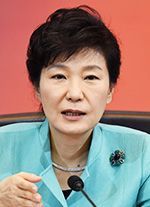
President Park Geun-hye
Cases of Park Geun-hye, Lee Myung-bak, Roh Moo-hyun
By Oh Young-jin
Regarding the title, here are a couple of personal disclaimers.
First, I am no anarchist. As a matter of fact, I believe strong presidents often mean strong states.
Thus, I make it a rule to support the heads of state and, only when necessary, try to provide constructive criticism.
Thereby, my primary point is about the system that often fails to cope with new challenges.
Just before the late President Roh Moo-hyun left office, he made an interesting observation.
“My biggest legacy as president is that I had become president.”
Roh meant two things. First, he overcame humble beginnings ― i.e. a high school graduate ― to be the occupant of the highest office in the nation.
Secondly, he was lamenting the lack of things he could do as the most politically powerful man, with much of his agenda pulled apart by a complicated web of competing interests.
The irony was that even his supporters turned into naysayers about some of the most pivotal projects he had his heart out for.
The opposition against him came most from the conservative forces ― namely big-circulation newspapers, the main opposition Grand National Party ― predecessor to the ruling Saenuri Party ― linking their anti-Roh causes with the wealthy and educated voters who cast their ballots for Lee Hoe-chang, the former Supreme Court justice and law-and-order prime minister.
Lee Myung-bak, or MB, who dubbed himself as a CEO president, didn’t fare much better than his predecessor Roh.
In the 2007 election, Lee didn’t win an absolute majority but managed to get elected by the difference of more than 22 percentage points over his closest rival, Chung Dong-young.
The 2002 election had Roh finish ahead of Lee by less than 3 percentage points.
Despite the lopsided victory, MB didn’t clear his first big hurdle over his decision to resume the importing of U.S. beef. His beefy endeavor was swept by reports about mad cow disease, a combination that turned into anti-MB protests that brought his administration to a standstill for months.
Lee’s “Grand Canal” project degenerated into the four-river restoration project when environmental groups, together with other political interest groups, took issue. As a former construction firm CEO, Lee did what he thought he knew best, but even the river restoration project faces allegations of collusion among builders and irreversible environmental damage.
Lee called in a group of managing editors for lunch on one of his final days as president, but unilaterally canceled a customary after-meal question-and-answer session, obviously engrossed in the fates of his close associates mired in corruption allegations.
“Just have lunch,” he told the editors then.
For the incumbent President Park Geun-hye, it is risky to make a conclusion.
That, of course, doesn’t mean that Park has had her moments of political paralysis.
The Sewol disaster is the biggest challenge she has faced so far.
Although her handling of the situation leaves a lot to be desired, Park appears to be less impacted than MB by his American beef decision.
For that, the biggest credit goes to her traditional support base that has been entrenched since the 16-year rule by her father, Park Chung-hee, in the Yeongnam region, and the eastern parts of the country. The Parks are the first and only presidential dynasty in the nation’s modern politics.
Phenomenally speaking, however, the current President Park may have to thank the long-running ideological divide as well.
Families of the victims ― most of them high school students from the working town of Ansan ― have, perhaps as many expected, found their political support in the opposition parties and progressive NGOs, pitting them against the government.
This is a template situation for any issue of political significance, causing conservatives and liberals to get divided and engage in their familiar tug of war. In the process, the issue at heart gets politicized, and then is made less relevant, yielding to partisan wrangling.
The Park government also follows the set pattern, as it found itself relegated to an interest group in the pension reform controversy ― putting the brakes on the agreement by the ruling and opposition parties.
In this case, it remains to be seen which one is better ― a bad agreement and no agreement.
To be continued.