'I will never forget support'
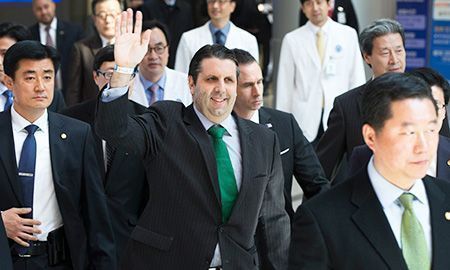
U.S. Ambassador to Korea Mark Lippert waves to supporters as he walks out of Yonsei University Severance Hospital in western Seoul, Tuesday. He was treated there for five days after Kim Ki-jong, a radical activist, attacked him with a knife. / Yonhap
US Ambassador Lippert released from hospital
By Jung Min-ho
U.S. Ambassador to Korea Mark Lippert expressed “profound gratitude” Tuesday for the support he received from Koreans in the wake of his being injured in a knife attack, adding that the “unbreakable bond” between Korea and the United States will remain strong.
“I feel pretty darn good,” he told reporters, wearing a cast on his left arm, before leaving Yonsei University Severance Hospital in western Seoul.
“I want to express my profound gratitude to those Koreans and Americans alike who bravely, gratefully and selflessly responded to the scene of the attack, and the medical team that delivered world-class treatment.”
He said it has been “incredibly gratifying” for him and his family to see such expressions of empathy and generosity from the Korean people.
“The signs, offers of food, flowers, cards and well-wishes on Twitter, Facebook and our blog. These are the acts of kindness that touched us deeply,” he said.
“Robyn and I will never forget that you came to support us,” Lippert added, referencing his wife.
The ambassador was hospitalized Thursday after being attacked by Kim Ki-jong, a radical activist, with a 25-centimeter long knife at a breakfast seminar held near the U.S. Embassy in central Seoul.
Few expected the U.S. envoy would recover so quickly from his right cheek wound, which was 11 centimeters long and 3 centimeters deep, and his left hand injuries.
Lippert said the attack only strengthened his affection for the country, and the bond between Korea and the United States.
“We will continue to work to grow our relationship, not only in terms of our critical military alliance but also the viable economic ties, important diplomatic partnership and deep friendship between the Korean and American people,” he said.
Referencing his wife, infant son and dog, Lippert added, “Since arriving in Seoul in the fall, Robyn, Sejun, Grigsby and I have felt embraced and welcomed by Korean people. In return, we have made it our mission to be open and friendly and that will not change.”
He closed his comments by saying he will still be a “dongne ajeossi” and “Sejun appa,” which roughly translated means a “dude in the neighborhood” and “Sejun’s dad.” Sejun is the Korean middle name Lippert gave to his son, who was born here two months ago.
In a morning press briefing, Yoon Do-heun, head of Yonsei University Severance Hospital, said that doctors removed the remaining half of the stitches from Lippert’s face.
“He is in very good condition,” Yoon said. “He stayed awake until 2 a.m., dealing with personal matters, and then got up at 7 a.m.”
Lippert’s blood pressure, pulse and body temperature have returned to normal levels, Yoon noted.
“While he feels little pain in his cheek, he still has minor wrist pain,” Yoon said. “He seems concerned about his wrist. Doctors plan to visit him every day to treat the injury.”
Doctors believe it will take three to four weeks to remove the cast from his arm.
“For his dinner on Monday, Lippert had rice, soybean soup and grilled beef ribs. And for his breakfast on Tuesday, he had rice and jangjorim (beef boiled down in soy sauce),” Yoon said.
Jung Nam-shik, head of the Yonsei University Health System, also said Lippert’s arm injury needs regular treatment and check-ups to prevent infection.