Chung quits NPAD to help form new party
By Lee Ji-hye
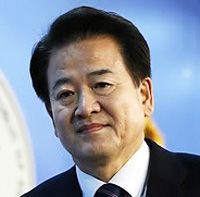
Chung Dong-young
Former presidential candidate Chung Dong-young left the main opposition New Politics Alliance for Democracy (NPAD) Sunday to help create a new party composed of civic group leaders and noted scholars.
It remains to be seen whether Chung joining the “Union of the People” can encourage other like-minded liberal figures to join the party, causing a split in the opposition camp.
“I’ve thought about leaving the NPAD for a long time and finally decided to join the drive to create a new party to respond to the mounting calls from the public,” Chung, a senior NPAD advisor, told a news conference at the National Assembly in Seoul.
“Several figures representing the liberal camp and democracy fighters have joined the Union of the People. And I share their cause calling for liberal politics, peace, ecology and a welfare state.”
Chung claimed the liberal camp was responding to calls for a new, alternative path that goes beyond the NPAD and progressive parties.
“I was convinced that joining the new party is the only way that can lead to a government change from the conservative Saenuri Party to the liberal camp in the next presidential election,” he said. “I was determined to do my last service in the political arena in this party.”
Chung, who unsuccessfully ran in the 2007 presidential election, blamed the NPAD for failing to represent the best interests of working-class families. He said the main opposition party represented the vested interests of middle-income and upper-income families, and had failed to differentiate itself from the ruling Saenuri Party, portrayed as a party for the rich.
Analysts had mixed reactions to Chung’s move.
Heo Jin-jae, an executive of research company Gallup Korea, said a new liberal party was not good news for the NPAD.
“In March last year when Rep. Ahn Cheol-soo joined the NPAD, the party’s rating hit the mid-30 percentage range,” he said. “Now support for the NPAD hovers at only 20 percent. “Nearly 15 percent of NPAD supporters withdrew their support because they were disappointed at how the party handled key issues. The division of the opposition camp will make things worse for the NPAD.”
Shin Yule, a political science professor of Myeongji University, played down the impact of the new party.
“There is a gap in political orientations between those who push for the new party project and moderates of the NPAD,” he said. “So I think the impact won’t be as huge as some speculate.”
On Dec. 24, about 100 well-known figures, including former Seoul National University Prof. Kim Se-kyun, held a news conference to announce they would create a political party that would truly represent liberals, excluding those sympathizing with North Korea. The nascent party also includes religious and labor leaders and people in the art and culture industry.
From Monday, they plan to hold conferences and seminars in large cities and provinces to rally support and pave the way for a new liberal party.
The drive to create the party has drawn media attention after a recent public opinion survey showed positive public reaction to the plan.
A Human Research poll of more than 1,500 people on Dec. 30-31 found that support for the new liberal party stood at 18.7 percent, compared with the NPAD’s 21 percent.
Nearly 40 percent of respondents agreed that a new liberal party was needed to better represent working-class and lower-income families.