Building both linguistic and cultural competence
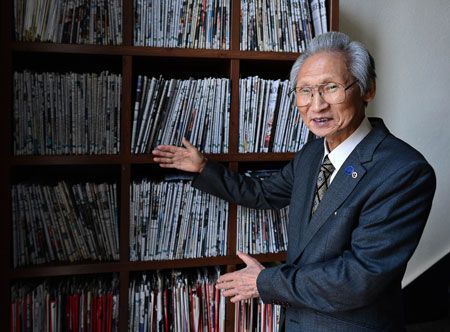
Dr. Park Myung-seok, a professor emeritus at Dankook University, poses beside the bookshelf stacked with copies of The Korea Times at his office in Seocho-gu, southern Seoul, on Oct. 22. / Korea Times photo by Shim Hyun-chul
Reading English dailies helps students master communication skills
By Chung Hyun-chae
Dr. Park Myung-seok, a professor emeritus at Dankook University, said that readers of English newspapers can develop both linguistic and cultural competence.
“By reading English dailies, one can kill two birds with one stone: keeping up with news happening in Korea and across the world, and learning practical English,” Park said.
“These newspapers help the readers grasp what is happening in every corner of Korean society and the world, including political, economic and culture news. It also enables them to understand different cultures,” he added.
“It is important to have both linguistic and cultural competence as well as creative thinking, which can contribute to developing cutting-edge technology, in order to keep pace with a rapidly changing information and technology age,” he said.
Understanding of cultures
While working to incorporate intercultural ideas into English language teaching, Park came to realize that young Koreans desperately need to interact effectively with people of different cultures. He believes that English newspapers can help students do so.
“It is crucial to have cultural competence to survive in the international community. For example, if Samsung goes to Australia to sell smartphones, they should know about the culture of the country in advance,” he noted.
“In order to make cold calls and articulate their products to foreigners, understanding their way of thinking is a prerequisite,” said Park, who is an avid reader of The Korea Times, the nation’s first English daily.
As for the “Thoughts of the Times” column and “Dear Abby” published every day in The Korea Times, he said readers of the newspaper can have a better understanding of how Westerners think and feel, as well as their attitude toward life.
“Students don’t need to go abroad to learn English or cultural differences since they can learn from The Korea Times here,” Park said.
Practical English
The Korea Times is no longer the only English daily in Korea. But Professor Park said he still reads it instead of other English newspapers. He has been subscribing to the Times for more than five decades, since his college days.
“There are several reasons why I have hailed The Korea Times for a long time. Firstly it has a 64-year history which is the oldest English daily in Korea,” he said.
“During the last 60 years, the newspaper has tried to keep impartiality by covering a wide range of news. I also like to read articles written by foreigner columnists of various fields,” he added.
He recalled that when he was a college student at the Hankuk University of Foreign Studies (HUFS) in the late 1950s, he took English lectures by Park Solemn, the second president of the university, who strongly recommended that his students read The Korea Times.
“Professor Park used the Times as teaching material and explained to us how living language differs from the literary language of Shakespeare, Milton and others,” he said.
“Idiomatic expressions that were written in the newspaper came as a refreshing surprise to me. And I felt that practical English I came across at that time was authentic English language.”
Park stressed the importance of the idiomatic expressions which he believes are effective in making a sentence powerful.
“The sentence ‘I turned down his offer’ carries more impact than ‘I reject his offer.’ Likewise, ‘please cut down school expense” is stronger than ‘please reduce the school expense,’” he said.
Park also emphasized the impact of metaphorical expressions such as “breaking the ice,” which means making a social situation more informal or relaxed, and “bark up the wrong tree,” which means blaming a wrong person or following a wrong course.
He used what he learned from his mentor when he taught students at Seoul High School from 1962 to 1966. He encouraged students to read English papers.
“The best evidence proving that The Korea Times is great English learning material is my students. They are now successfully working both at home and abroad as globalists,” Park said.
Newspaper in education (NIE)
Professor Park wants to see universities use The Korea Times as teaching material for mandatory freshmen English classes. He also recommends high school students read The NIE Times, supplementary learning material published daily by the Times to help beginners learn English under newspaper in education (NIE) programs.
“I acknowledged that senior students have no time to read English newspapers, overwhelmed with study for the College Scholastic Ability Test to enter university,” Park said.
“But NIE is very helpful for students of different levels to develop their reading comprehension,” he added, while citing the Key Expression Corner in which readers can grasp key words and expressions from a news article.
“For example, ‘shrouded in mystery’ is a very good expression, which is commonly used among Americans but at the same time considered as high level. Like this, students can learn more vocabulary through The NIE Times,” Park said.
As one of the advocates of NIE, Park said he hopes the paper will also show how to pronounce words.
“To rightly pronounce a word is important in communication,” he said.
Advise for improvement
Aside from the NIE, Professor Park gave some advice for the improvement of the paper.
“I have in particular admired the ‘Thoughts of The Times’ section because it is full of challenging and daring ideas. I wish The Korea Times would invite more noted columnists to convey their diverse opinions and ideas to readers,” he said.
Park also suggested that the Times should make efforts to make the paper available for more students, especially those who cannot afford to subscribe it.
“I’m willing to support them if there are such demands,” Park said.
Who is Professor Park
Park graduated from the Hankuk University of Foreign Studies (HUFS) with a BA in English language in 1961 and did graduate work at Seoul National University from 1961 to 1964. He received a Ph.D. in literature from HUFS in 1974.
He went on to specialize in the Asian English teacher retraining program and intercultural communication at the East-West Center, the University of Hawaii in 1966-67 and studied sociolinguistics and communication at the University of Michigan, Ann Arbor, in 1967-68.
Then he served as professor at HUFS from 1968 to 1983.
While studying in Hawaii, Park attended intercultural communication lectures, which inspired him to ponder how to survive in a global community.
He established the Korea Communication Association in 1976. And he was a founding member of the Pacific and Asian Communication Association (PACA), which encompasses the Pacific Rim area.
Park was awarded the East-West Center Distinguished Alumni Award in 1980 in recognition of promoting better understanding among countries of East and West through intercultural activities.
He is now an advisor to the World Communication Association. He also serves as chairman of the board at Beautiful Community, Incorporated Association, a charity organization to promote love and sharing.