Chuseok: The grave weeders
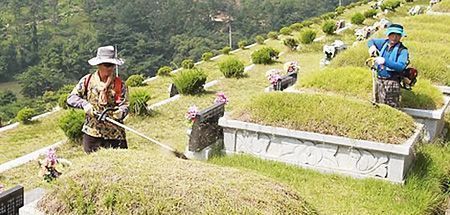
Family members tidy up the graves of their ancestors with weed-trimmers in Hamyang, South Gyeongsang Province. / Yonhap
By Lee Min-hyung
Every Chuseok, families head to cemeteries across the country for a special custom: tidying up the graves of their ancestors.
The ritual, called “beolcho,” falls in line with the thanksgiving holiday, which includes ancestral rites. These days, families often use gas-powered weed-trimmers to clean up the grave areas.
The custom has developed another modern twist.
Instead doing the maintenance themselves, a growing number of families are hiring “grave weeders” to do the job.
A self-employed worker, who asked to be identified by his surname Lee, is using such a service after a nightmarish experience in the past.
“My son, who came to help me with beolcho, nearly died after accidentally disturbing a bee hive,” he said. “He was too engrossed in using the lawn trimmer to pay attention to the hive.”
Experts advise people wear safety glasses and a facemask when performing the ceremony.
Safety issues are not the only reason people are hiring grave weeders. Time and money seem to be on their minds as well.
“It’s tough to keep doing it every year,” said Kim Hyung-joon, 27, who is currently living with his parents.
“We need to keep the lawn trimmer in good condition just for one day. It’s more economical to use the grave weeding service.”
A 54-year-old retiree speculated the trend may have to do with Korea’s aging society.
“Young people are reluctant to have a baby these days,” he said. “People over 50 make up almost 80 percent of my family. We are getting older and weaker and in a few years we’ll have no choice but to use the service.”
Despite the growing popularity of such services, many still head to the cemetery for beolcho.
“I do it on my own to pay respect to my ancestors,” said Lee, 54, who’s been completing the ritual for over two decades. “It’s the driving force that brings me back every year,”