Sinchon trying to regain past glory
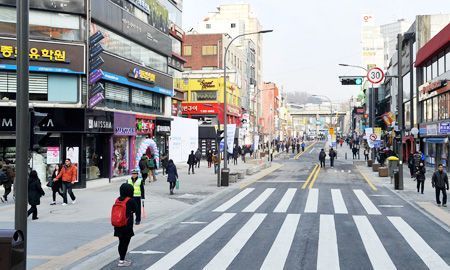
People walk on Yonsei Street of which car lanes were reduced to two from four to give more space for pedestrians. / Courtesy of Seodaemun District Office
By Joel Lee
Sinchon is carrying out a small but meaningful experiment to regain its past glory as a bustling university town in Seoul.
Its residents, civic groups and the Seoul Metropolitan Government (SMG) joined hands to make one of its main streets more friendly to pedestrians as part of moves to revitalize Sinchon’s waning culture and business.
On Jan. 7, the city designated Yonsei Street as an Exclusive Public Transportation Zone, allowing only pedestrians, buses, 16-person vans, emergency vehicles and bicycles to enter.
It reduced the 500-meter-long street from four lanes to two, allowing more space for passersby. All cars must drive under 30km per hour and taxis are only allowed between midnight and 4 a.m.
“Yonsei Street is expected to change from a functional road to a human-centered street,” said Chun Jung-wook, the chief of Transportation Policy Department of SMG.
Under the project, Yonsei Street, which runs from Sinchon Station to the front gate of Yonsei University, has been leveled and widened to become pedestrian-friendly.
“I am 98 percent satisfied with the new, unobstructed streetscape. I think even the buses which used to be stuck in the road traffic come quicker now,” said one passerby in his mid 20s, declining to be named.
Along the street, the city plans to plant 150 cherry trees, lay roadside flower pots and afforest the underpass wall. It also plans to remove on-road parking lots and introduce public bicycles.
On the cultural side, the city government and Sinchon Cooperative, a local commercial guild, plan to hold various cultural events.
“Sinchon’s cultural revival must focus on creating spaces for music,” said Ra Do-sam, a researcher of the Seoul Institute. “Urban revitalization of the university town must be led bottom-up and long-term in attracting cultural artists. The Government’s role must be limited to setting the background for the movement to blossom.”
Sinchon (meaning “new town”) has been a university town thanks to its location amid Yonsei University, Ehwa Women’s University, Seogang University and Myongji University.
From the ruins of the Korean War, it had thrived as a mecca for the resistant youth culture for decades through various independent artistic endeavors.
However, since the late 1990s its famous rock cafes, small theaters and concert halls have relocated to Hongdae, Daehangno and other places due to rising rents. The subsequent commercialization of the area invited large corporate franchises of coffee shops, restaurants, and clothing stores which destroyed its unique identity.
“I really wish Sinchon would be developed toward a more academic and cultural direction. There are too many bars and motels around here, which makes it feel more like an entertainment district than a university town. Restoring used bookstores might be a good idea to start with,” said Kang Yoonji, 22, a Yonsei University student.
Lee Tae-young, an official of Sinchon Renewal Forum, a civic group launched last November to discuss the future of Sinchon, said, “What is truly critical is not only restoring Sinchon’s commercial vitality, but creating a space full of life and culture.”
Lee Moon-hak, president of Sinchon Cooperative, said he expects Yonsei Street to help Sinchon regain its commercial vitality from this spring on.
“Through the synergy of the city government, civic organizations and local businesses, Seoulites may once again walk, enjoy and dream of Sinchon, a cultural new town,” Lee said.