'I saw my buddy killed'
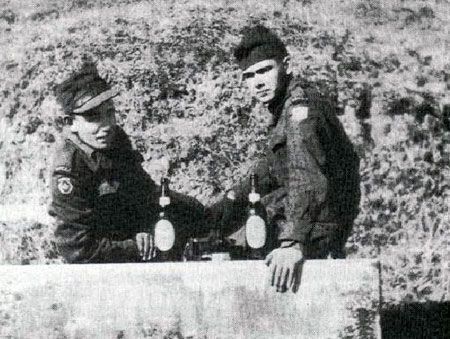
Acting Cpl. Vince Courtenay, right, of Princess Patricia’s Canadian Light Infantry, was with his buddy Pvt. Stanley Mudd during a lull after the Second Battle of Hook near Gaeseong. Mudd was killed in action days after this photo was taken. / Courtesy of Vince Courtenay
Canadian vet recalls fateful December night in 1952
By Vincent Courtenay
Vince Courtenay
In August, 1950, I was training in a militia regiment at one of Canada’s largest army bases in Ontario. We had listened to news about the possibility that Canada might send troops to Korea.
The country had already sent three destroyers of the Royal Canadian Navy to Korea. A Royal Canadian Air Force transport squadron was providing a transpacific airlift from Fort McChord air base in the State of Washington to Haneda air base in Japan.
So news that Canada would raise a Special Force of volunteers to fight in Korea was met with many cheers. The next morning I went into the base recruiting office and signed up. I had just turned 16.
Patriotism and enthusiasm were so high that in just two weeks Canada recruited more than 8,000 volunteers to this highly colorful brigade.
After the landings at Incheon in September, 1950 by American forces and their breakout from the Busan Perimeter, many of us were concerned that the war would end before we arrived in Korea.
The 2nd Battalion of Princess Patricia’s Canadian Light Infantry was sent in November. While they were at sea, the United Nations Force and the Republic of Korea army units were driven back out of North Korea. Battalions of the Chinese People’s Volunteer Army had joined in the battles in overwhelming numbers.
The Patricias completed their training at Miryang, then joined the British 27th Brigade and fought their way northward. It was a much different war to the battles the Canadian officers and senior NCOs had known during World War Two. For the most part, the attacks involved a single company of infantry on a single hill.
Yet it was deadly and it was horribly hard. Although many of the Canadians were tough from working in the forests, mines, or fishing at sea, the Korean hills were rugged indeed. Fighting uphill, on frozen slopes, with an enemy firing downward and throwing grenades, would tax any athlete’s strength, or any soldier’s courage.
The troops were physically pressed, as well as in constant danger. Veterans of World War Two were astonished that when they attacked with 40 or 50 soldiers, they were hitting positions held by two or three times that number of enemy troops.
They fought on. They had many casualties, but they pushed the enemy back almost to the 38th Parallel.
The rest of the Canadian Brigade arrived at the beginning of May. The 2nd Battalions of The Royal Canadian Regiment and the French speaking Royal 22e Regiment, disembarked and went right to the front. So did the tanks from the Lord Strathcona’s Horse (Royal Canadians) along with the guns from the Royal Canadian Horse Artillery, as did a field hospital, squadrons of engineers and mechanical engineers, and supporting transport from the Royal Canadian Army Service Corps.
The 25th Canadian Infantry Brigade pushed the enemy forces in their sector back to the 38th Parallel and took several prominent positions that are now within the present day DMZ.
One of them, taken by British and Australian units, is the infamous Hill 355, or Kowangsan. Later on, more Canadians were lost on that position, or in patrols around it, than in any other location in Korea.
The Canadians were to stay on the line for the remainder of the war, and the 3rd Battalion of the Princess Patricias held Kowangsan on July 27, on the night that the guns went silent.
But they remained in battle for more than two more years. As the truce talks dragged on, first at Gaeseong and then at Panmunjom, battles continued to rage all across the front. Some who served then will say that as time went by, things actually became worse.
The enemy amassed more and more artillery and became very skilled at using it. When they hit any position in strength, it was not uncommon to fire 5,000 or more shells onto a few defenders.
More than 27,000 Canadians were to serve on land in Korea and close to 5,000 more served by sea in eight Canadian destroyers that were dispatched to Korea throughout the war.
Additionally, 24 Canadian fighter pilots served on loan to the U.S. Air Force and flew sabre jet interceptors in MIG Alley over North Korea. Upwards of 50 nurses of the Royal Canadian Air Force worked on American air ambulance flights that brought wounded soldiers home from Korea.
In the war years Canada had a population of less than 14 million – but it had the third largest allied force in the field in Korea, following the United States and the United Kingdom.
Of the Canadians who served in Korea, 378 are buried in the United Nations Memorial Cemetery in Busan, another 16 could not be recovered and rest in unmarked graves where they died, and 20 are buried in a Commonwealth military cemetery near Yokohama, Japan. Additionally 102 soldiers who served in the Brigade are buried in Canada.
Today it is estimated that only 6,000 of the Canadian veterans who served in Korea are still living. The survivors are passing away with ever increasing frequency.
Vincent Courtenay fought in Korea with the Princess Patricia’s Canadian Light Infantry at age 16 and is now visiting Korea as part of the Canadian delegation to the 60th anniversary of the Korean Armistice. — ED