Dispute looms over wartime OPCON
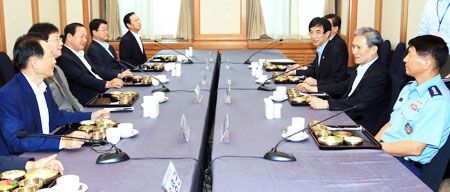
National Defense Committee’s Saenuri Party lawmakers including Yoo Seong-min, second from left, talks with Air Force Chief of StaffSung Il-hwan, right, and Defense Minister Kim Kwan-jin, second from right, about the transfer of wartime operational control (OPCON) and the F-X program at the National Assembly in Seoul, Thursday. / Yonhap
By Kim Tae-gyu
Domestic experts are split over whether South Korea should have asked the United States to delay the transfer of wartime operational control (OPCON) slated for December 2015.
Citing mounting threats of North Korea including its nuclear program, the Ministry of National Defense requested the postponement.
“The Park Geun-hye administration regards peace just as a concept of security based on maintaining the status quo. It is not aware that peace is also about the two Korea’s increased collaboration in the future,” said Chang Yong-seok at the Institute of Peace and Unification Studies affiliated with Seoul National University.
“For closer collaboration, we should change the attitude of over-dependence on the U.S. and to that end, we should get back the wartime OPCON as planned. Then, we will be able to take a step forward.”
Others take issue with the fact that President Park promised to retake wartime control as scheduled during her election campaign last year and confirmed this after she took office.
With this timetable in mind, Seoul took a leading role in this year’s joint military exercises with Washington for the first time.
However, the atmosphere changed after the North’s third atomic test this February. The U.N. responded with stringent sanctions, which prompted North Korea to ratchet up war threats against South Korea and the U.S.
Amid the continuing verbal attacks this spring, Seoul is known to have requested consultations on the OPCON change schedule with Washington.
“If the transfer is put off once again, the nation will face criticisms that it always jumps into the arms of the U.S. in dealing with its own national defense,” said Chang who worked for the late former President Roh Moo-hyun.
“We have to end the U.S. right to control our armed forces in case of war.”
Under the stewardship of the liberal head of state, the South signed the transfer of the wartime control in 2006, more than half a century after it was handed over to the U.S. soon after the Korean War (1950-53).
It was supposed to take place in April 2012, but the former Lee Myung-bak administration postponed it by more than three years in 2010 after the South Korean frigate Cheonan was sunk by an unprovoked torpedo attack.
Seoul is seeking a second deferment possibly beyond the Park administration, which ends in Feb. 2018.
“When the transfer was first signed in 2006, there were assumptions that our military capabilities would substantially improve by 2012. But that simply didn’t happen,” said Shin In-kyun, head of the private Korea Defense Network.
“Things are similar now. In terms of intelligence on the North, we rely 100 percent on the U.S. In this climate, we cannot recover wartime control. You need to know that the issue is about a grim reality, not an ideal one.”
Shin expected that the country will be able to take over wartime OPCON around 2030 only after its grandiose scheme of dramatically improving military power proceeds well.