June 12 ministers' talks confirmed
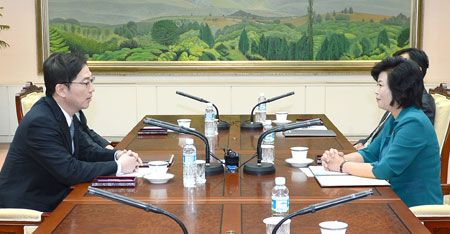
Chief South Korean delegate Chun Hae-sung, left, and his North Korean counterpart Kim Song-hye, sit face-to-face prior to the start of a working-level meeting at the truce village of Panmunjom, Sunday, to map out the details for Wednesday’s inter-Korean ministerial meeting. / Yonhap
By Chung Min-uck
South and North Korea agreed to hold a ministerial meeting in Seoul this Wednesday to discuss a wide range of issues including reopening the Gaeseong Industrial Complex, restarting tour programs to Mt. Geumgang and reunions of families separated by the Korean War (1950-53).
But the two sides had a hard time narrowing the gap over some details for the Seoul talks, including agenda setting and delegation size.
The ministerial-level meeting between the two Koreas will be the first since 2007 and could ease the frosty bilateral relations of the past five years with virtually all exchanges at a standstill.
“The two sides shared the same understanding in regards to the ministers’ meeting during the talks,” said unification ministry spokesman Kim Hyung-suk, in a briefing Sunday after the morning session of the preparatory working-level meeting in the truce village of Panmunjeom.
Seoul last week offered Pyongyang a ministers’ meeting after accepting its suggestion for government-to-government talks to resolve the heightened tension on the Korean Peninsula.
The working-level meeting, which initially began at 10:13 a.m., continued into the afternoon. Chun Hae-sung, head of the ministry’s policy setting office, and Kim Song-hye, a senior official of the North’s Committee for the Peaceful Reunification of Korea, led their the three-person delegations, respectively.
“There is a need to build trust from small issues and the South’s goal is to keep faithful to the principle of trust-building on the Korean Peninsula,” Chun told the reporters before engaging with the North at the joint security zone.
Trust-building is the main policy goal of President Park Geun-hye regarding North Korea, and calls for both a principled and flexible approach towards the North based on its behavior.
A ministry source said the afternoon’s working-level talks made slower progress as the two sides were having a hard time ironing out differences in agenda setting, size of the delegation and duration of the talks.
“The North did not budge from its position on certain issues throughout the day and from views expressed earlier,” the source said. “But the differences could not be viewed as being insurmountable.”
The afternoon session of the talks continued until midnight and the two sides are expecting to adopt a final agreement on details for the ministers’ talks.
Another source, who declined to be identified, said two sides were in agreement on holding the ministers’ meeting for more than a day.
Inter-Korean relations have lately dipped to one of their lowest points following the North’s nuclear test in February. It was followed by the United Nation Security Council imposing sanctions on the Stalinist regime for violating its previous promises.
Angered by the U.N. move and series of military drills conducted jointly by the U.S. and South in the past few months, the North severed all communication channels with the South including a military hotline and one at Panmunjom. It also verbally threatened a pre-emptive nuclear strike against the U.S. and the South.
Watchers say North Korea’s sudden shift of stance to engagement aims at avoiding diplomatic isolation which could undermine its dual course of achieving economic improvement and nuclear development under the new leader Kim Jong-un who took office in April 2012.
China, the North’s sole ally which wields substantial influence politically and economically, has frozen its dealings with the North’s Foreign Trade Bank in line with the sanctions imposed by the U.N.
President Xi Jinping, on numerous occasions including the U.S.-China summit held during the weekend in California, stressed China’s stance of wanting a denuclearized Korean Peninsula. This is in line with other six-party nations, which have long called for the North’s denuclearization as pre-condition for engagement.
President Park is scheduled to meet with Chinese President Xi on June 27 in Beijing to solidify cooperative measures on the North.
Seoul, Washington and Beijing will also hold a trilateral meeting at the end of this month, the first of its kind.