Old alley tells story of war, poverty and development in Busan
By Kim Jae-won
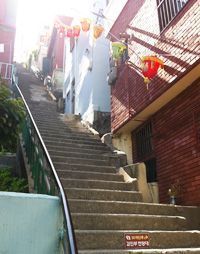
The 168 Steps are one of the tour spots of the 1.5 kilometers of back alleys, called “Ibagu-gil (story trail),” in Choryang-dong, Busan. / Korea Times photo by Kim Jae-won
BUSAN ― This southeastern port city is well known for its beautiful beaches, one of the biggest Asian film festivals and a ballpark filled with “crazy” fans.
However, not many people know that it was home to millions of refugees who fled to the interim capital of South Korea during the Korean War (1950-53). Some of them gathered at a hilly village in front of Busan Station called Chorayng-dong to make a livelihood.
Since then, the residential area has gone through the nation’s economic development in the 1960s and ‘70s and modern redevelopment in the 1990s and 2000s. Seeking to use its abundant historic and cultural assets, the local office of Dong-gu in Choryang-dong launched a tour program in March of the 1.5 kilometers of back alleys, called “The Story Way” after three years of preparations.
“Dong-gu has many modern and contemporary historical heritages because it has been the center of the city. We made the route to let visitors enjoy them conveniently,” said Ha Eun-sook, an official of the office.
Ha said that the office set up a photo gallery on the wall of Choryang Elementary School, which has some 100 years of history, to remember figures from the region. The list includes popular entertainers, such as singer Na hoon-a, comedian Lee Kyung-kyu and musical director Kolleen Park.
Photos of poet Yu Chi-hwan, one of the best poets of his age known for his powerful and touching lyrics, and surgeon Chang Kee-ryo, who treated the poor with the first modern health insurance system, were also exhibited.
At the top of one alley, visitors can find a cafe named “Cheonjippekkari” ― a Busan dialect translated into “Everything you want” ― where owner Kwak Tae-nam, 58, serves a delicious red bean milk tea and tells a story of poverty and development in the area.
“It has changed a lot. It was originally a residential area for war refugees who built houses with used wooden boards. Later in the 1960s and 1970s, people lived in tents coated with asphalt. Now everybody lives in slate houses.”
She has lived in the village for most of her lifetime, except for three years when she lived in Minrak-dong after her marriage.
There is also a unique post box titled “Yearning” set up for those wanting to send messages to loved ones. The letters are mailed a year later to transfer the senders’ feelings more deeply.
Other historical heritage sites, such as the city’s first modern hospital, Baekje Hosptial, established in 1922 and the 121-year-old Choryang Church which former President Syngman Rhee attended during wartime, also attracts the attention of visitors.
When a person tires of walking, there is the Kim Min-bu Memorial Viewpoint which offers a scenic view of the North Port. Kim is the author of “Waiting Heart,” a song about a wife who waits for her husband who left her.