Kim Rahn is the managing editor of The Korea Times. Since joining the company in 2003, she has covered various beats including the presidential office, Seoul city government, the Bank of Korea and the tourism industry. In 2014, she won the Society of Publishers in Asia (SOPA) award for her coverage of the ordeals of migrant women in Korea.
Cabbies skeptical of 'taxi bill'
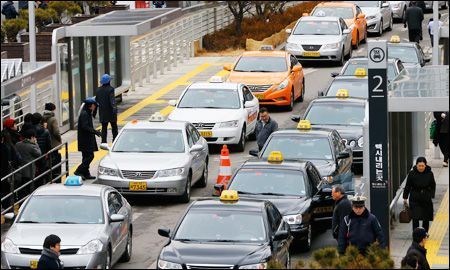
Taxis stand in a queue, waiting for passengers, in front of Seoul Station, on Jan. 22. Taxi companies are calling for the passage of a bill to include taxis as public transport, while many cabbies say the measure will not benefit them but only the firms they work for. / Yonhap
By Kim Rahn
Companies likely to share only small benefits with drivers
By Kim Rahn
Lee Kyeong-sik, a taxi driver in Seoul with four years of experience, gets 1.2 million won in monthly salary from his taxi company.
Besides that, he can take daily earnings after subtracting fares he has to turn over to the firm, about 110,000 won. However, the remainder is only 20,000-30,000 won for 12 hours of hard work a day.
Despite the low income and poor working conditions, he opposes the controversial “taxi bill,” which was designed to include taxis in public transport and thus expand financial and other benefits for them.
“I think the bill, if it goes into effect, will not be actually helpful to drivers but will only benefit the companies. The firms will share a very small portion of the subsidies with drivers. Owner-driver cabbies may get larger benefits than us,” he said.
“If a taxi is recognized as public transport, we’ll face more and stricter regulations. The law will only aggravate the situation without any actual salary rise. I don’t know for whom the law is being promoted,” he said.
Despite such skepticism from taxi drivers, taxi companies and cabbies’ union leaders eagerly want the bill to be passed by the National Assembly, saying they will call for a strike if it is not passed.
The bill was initially passed at the Assembly on Jan. 1 with bipartisan support, but President Lee Myung-bak vetoed it on Jan. 22 following negative public opinion and opposition from the Ministry of Land, Transport and Maritime Affairs.
Four groups representing taxi drivers’ unions and taxi companies protested the veto. “We’ll stop taxi operation on Jan. 30 in Busan, on Feb. 1 in Gwangju and on Feb. 20 in Seoul. If the Assembly doesn’t re-pass the bill, we’ll launch a nationwide strike for an indefinite period starting Feb. 21,” Lim Seung-un, a director of the Federation of Korean Taxi Workers’ Unions, said.
However, the re-passage is unclear, because both the ruling Saenuri Party and the main opposition Democratic United Party recently backed down on their initial strong support for the bill. It comes against the backdrop of the fact that they both actively promoted it during the buildup to the presidential election in December ostensibly to win the votes of taxi drivers.
The recent U-turn must have been influenced by the fact that public polls showed the majority of citizens oppose the bill, with a poll saying over 60 percent of people consented to President Lee’s veto on the “populist” motion.
Now the parties say they will decide on the re-passage after reviewing the ministry’s plan to establish an alternative for the taxi industry. This includes various measures such as tax breaks, public depots and financial support for restructuring taxi firms.
Lim meanwhile insists that the taxi industry is opposed to the alternative plan.
“It will not be effective. Cabbies’ working conditions will get better if they are recognized as workers engaged in public transport, like bus drivers,” he said.
“We are not demanding the government give us huge subsidies right now, but demanding it re-establish its public transport master plan with taxis included,” he added.
Regarding drivers’ skepticism about the taxi bill, he said, “They are not well informed.”