Kim Rahn is the managing editor of The Korea Times. Since joining the company in 2003, she has covered various beats including the presidential office, Seoul city government, the Bank of Korea and the tourism industry. In 2014, she won the Society of Publishers in Asia (SOPA) award for her coverage of the ordeals of migrant women in Korea.
`Little Tokyo' in Seoul disappearing
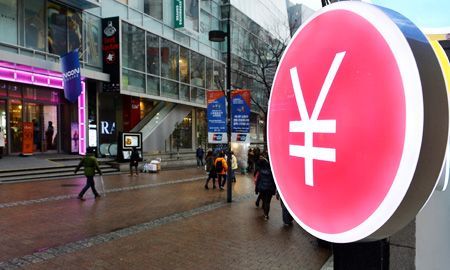
A street in Myeong-dong, central Seoul, is empty as the number of Japanese travelers to Korea has sharply dropped due to the weak yen. / Korea Times photo by Shim Hyun-chul
By Kim Rahn
By Kim Rahn
Myeong-dong was something close to Little Tokyo in the heart of Seoul with Korean vendors hawking their goods in fluent Japanese.
Chinese tourists are taking over the shopping district by their sheer numbers but that seems not enough to explain the disappearance of Japanese visitors.
“I think the number of Japanese has fallen by about 20 percent,” said Jeong Hee-sun, a clerk at a cosmetics shop.
“The figure began falling around September, and it is getting smaller this year. Japanese customers also used to buy cosmetics in bulk, but now they buy in small amounts,” she said.
Lately, the weak yen seems to be the biggest reason for their reduced numbers.
A lower yen aggravated the situation from around December. The won-yen exchange rate was some 1,500 won per 100 yen at the beginning of 2012, but is now less than 1,200, reducing Japanese tourists’ purchasing power.
“Along with the weakening yen, the economic situation in Japan is not good, with companies there reducing incentives and bonuses. The downward trend of Japanese visits to Korea may continue this year,” said Kim Dong-hoon, a Lotte Duty Free shop worker.
The Korea Tourism Organization (KTO) said the total number of Japanese travelers in 2012 rose by 7 percent from 2011 due to a huge influx until August. But the monthly figure began dropping in September — some 269,700 people came to Korea in October, 20.7 percent down from a year before. It fell to 249,400 in November and 227,200 in December.
A red-jacketed staffer of the Seoul Tourism Association said Japanese visitors accounted for about 80 percent of tourists about a year ago when she first began working.
“Now they account for about half. Chinese and other Asian nations’ people have taken up the slack,” said the staffer who asked for anonymity.
The downturn of Japanese arrivals has hit the hotel and airline industries as well.
Lotte Hotel Seoul, where about half of the guests are Japanese, said the number in the last quarter of 2012 decreased by 30 percent from the same period in 2011.
Jeju Air suspended operations between Jeju Island and Osaka on Jan. 1, while Korean Air also suspended its Jeju-Nagoya flights on Jan. 7.
Merchants and people in the tourism industry say the drop was triggered in August when President Lee Myung-bak said Japanese Emperor Akihito must apologize for the atrocities committed during the 1910-1945 colonial rule should he want to visit Korea.
“The political, diplomatic issue was a big blow, and the tension has continued. Especially group tourists have avoided coming to Korea, because they are afraid they may be criticized for visiting Korea amid such a diplomatic dispute,” Lee Byeong-chan, Japan team manager of the KTO, said.
Yuki Sakuma, a Japanese woman making a trip to Seoul, said, “The popularity of hallyu is still high in Japan. The decrease in the number of visitors may be from the Takeshima issue.” (Japanese call South Korea’s easternmost islets of Dokdo, over which they have frequently laid claim, Takeshima.)
Ko Ho-seung, who sells “hotteok,” Korean-style sugar pancake, in Myeong-dong, said, “According to Japanese customers, immigration officers at Japanese airports tell them to be careful in Korea, saying anti-Japan sentiment here is very strong nowadays.”
He said his sales have dropped by 30 percent over the recent few months.
Lee of the KTO said the currency issue may not be resolved soon, but he hopes diplomatic tension will be eased when the Park Geun-hye administration takes office.
“It is likely that the two nations will see a new, improved relationship with the new president. If so, Japanese media will resume covering Korean culture and tourism. They have avoided doing so since August,” he said.