President gives businesses pep talk
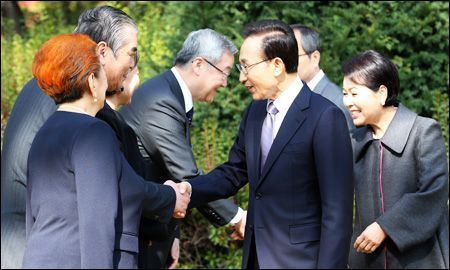
President Lee Myung-bak shakes hands with Uzbek Ambassador Vitali Fen, dean of diplomatic corps here, during a meeting with envoys stationed in Korea at Cheong Wa Dae, Monday. / Yonhap
By Kim Young-jin
President Lee Myung-bak stressed the need to boost the morale of businesses Monday so that they can work harder to cope with the lingering economic downturn and a low-growth trend.
Concern has been growing here since Bank of Korea data showed last week that the nation’s economy grew 0.2 percent in the three month period from July, marking the lowest rate in nearly three years.
“The nation is expected to see slower growth and enter a low-growth era, though the nation has so far performed well compared with other nations in the world. The steady appreciation of the Korean won is aggravating concern,” he said during a bi-weekly radio address.
Lee showed confidence that the nation will manage to overcome these hardships and achieve a turnaround soon.
“Now we need to make combined efforts among the government, business and the public to increase investment and create more jobs,” Lee said.
“At a time when we face a tough situation, we need to encourage entrepreneurship and business people should exercise challenging spirits.”
Lee’s statement came amid growing calls for a so-called “economic democratization” in the political sector ahead of the Dec. 19 presidential election.
Against this backdrop, Lee has expressed concern about rising "anti-business" sentiment because leading presidential candidates from both ruling and opposition parties have been calling for the need to tighten control over the conglomerates under the slogan economic democratization.
Conglomerates have expressed anxiety over the move, describing it as a politically-motivated populist issue in the run-up to the presidential election.
Lee pledged efforts to actively support and encourage all businesses, big, as well as small- and medium-sized businesses (SMEs), just as it did during the 2008 global financial crisis.
Lee also hailed a series of Korean achievements in diplomacy and green growth.
In the last couple of weeks, Korea was elected to the U.N. Security Council; won the right to host the secretariat of the Green Climate Fund (GCF), a massive U.N. climate fund; and saw the launch of the Seoul-established Global Green Growth Institute (GGGI) as an official international organization.
In particular, Lee said the GCF secretariat will bring "enormous" benefits.
"In the beginning, thousands of staff members will reside in Songdo, Incheon. In addition, about a hundred conferences will be convened annually, which means that the city will host international conferences almost all the year round," Lee said.
"This is not a singular event such as the Olympics or the FIFA World Cup. This permanent organization will be scaled up as the years go by, thereby making significant contributions to the national economy," he said. "The fact that a large-scale international body is headquartered in Korea is also a huge security issue."