My life at a Korean law firm (part 28)
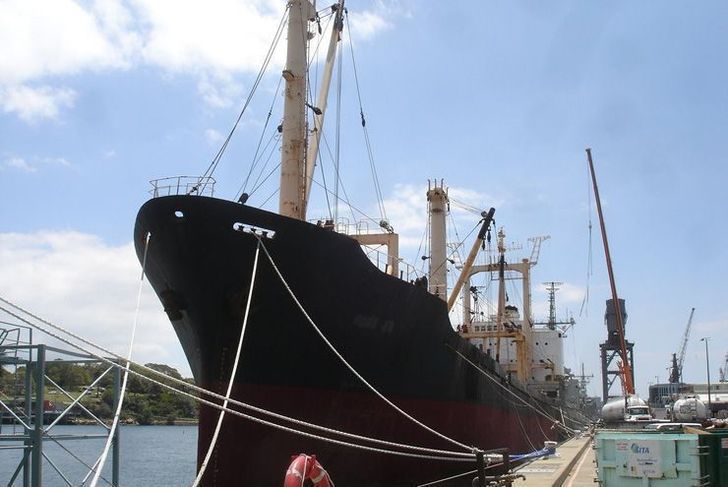
A North Korean ship named the Pong Su / Yonhap
The Pong Su (part 1)
By Jacco Zwetsloot
During the almost 4.5 years my wife and I lived in Melbourne there were a number of Korea-related events that took place in Australia.
In April 2003, a North Korean ship named the Pong Su was apprehended by the Australian Navy on suspicion of smuggling 150 kilograms of high grade heroin into Australia, at the Victorian coastal town of Lorne. The Australian Federal Police had been watching the ship from shore, and while the Pong Su was anchored off the Victorian coast a rubber dinghy carrying two men had brought heroin to land. The weather conditions were rough, so the dinghy overturned, drowning one of the two men and causing the loss of one of the bales of heroin. The rest was picked up by a waiting party of two men who loaded the heroin into a small car and drove back to Melbourne, leaving the other man from the dinghy, who was eventually picked up by the police in a search of the shoreline. The driver and passenger of the car were also stopped and arrested with the drugs in their vehicle.
The Pong So left the scene and was trying to leave Australian waters when they were stopped by naval vessels and a helicopter. The 35 or so sailors on board were brought to Melbourne and were remanded in Barwon Prison while waiting for their committal hearing. I decided to make a prison visit to see how the men were being treated and to see if they needed anything. So I made the long drive to the jail and checked in through the onerous security screening.
An entire wing of the prison which had been cleared out for renovations was being used to house these men from the Pong Su. They were being held separately from the Australian population, and were being treated quite well as far as I could make out. Most of the day they were allowed to spend outside their cells playing ping pong, watching television and even doing some limited cooking for themselves. But they had lost all their possessions that were on the ship including their reading glasses (those who wore them). I made a list of the names of the sailors who needed new glasses, and the strengths they required.
While there I met a South Korean immigrant pastor who ran a local mission to seamen in Geelong. He was much closer to the prison and was making regular visits. He was able to bring them some quantities of Korean food such as kimchi and red pepper powder or paste. He took care of obtaining the glasses for the men, too.
I tried to engage with the men about their lives as sailors and their journeys around the world, but they seemed reluctant to talk in detail, even in Korean. One of the men there was the ship's “political officer,” which presumably meant he was a member of the Korean Workers' Party and one of his duties was to ensure operational security and ideological purity of the members.
The next time I visited, I brought every paper Korean-English dictionary that we had at home, and some Korean community magazines or newspapers. I also took a couple of video cassettes. One was a copy of a North Korean movie, “The Nation and Destiny;” another was a video of North Korean karaoke; and a third was a copy of the South Korean movie JSA. On my third visit, I found the last of these videos, together with the Australian-produced Korean language publications, wrapped in paper and hidden behind the television. It was clear that someone had decided that this was not kosher viewing. I am not sure if any of the men ever saw the film. Perhaps the political secretary did.
On maybe my second or third visit, I met a Mister Chon, who it turned out had flown especially from Pyongyang to procure the best defense that money could buy. Mr Chon had hired a Queen's Counsel, or QC, which is the most esteemed, experienced (and expensive) lawyer that money can buy in Australia. This QC had sent a junior associate to the prison with Mr Chon to meet with his clients. Mr Chon was affable enough and spoke some English. He told me he was one of seven owner-directors of the Pong Su company, which was a privately operated shipping firm that had no links to the North Korean government. Mr Chon was staying alone in a Melbourne hotel. I remember we took a taxi once and he paid for the ride with a hundred dollar note.
Mr Chon didn't stay long; he returned to North Korea and returned a month or so later with a Mr Kim who, I was told, was to be a translator for Mr Chon. This seemed unlikely since Mr Kim's English was poorer than Mr Chon's, and the latter had handled himself just fine without the former on his first trip. A more likely explanation was that North Koreans usually always travel in twos when on overseas business trips, so that they can keep an eye on each other in case of trouble.
Mr Kim had brought with him some North Korean paintings that he wanted to sell. I asked for more information, because I had an interest in them if they involved any propaganda art. Unfortunately, they were all bog standard landscapes with maybe a few tigers thrown in. Mr Kim asked me if I knew any Australian dealers or art collectors who might want to buy them off him. I had no connections to the art world, and told him so, but every time we met, he would ask me the same thing. Eventually he complained about the money he had lost in bringing these artworks to Australia, so one day I said to him, “Mr Kim, you sound more like a capitalist than a socialist!” He just laughed and kept looking for a way to sell those paintings.
On one occasion I brought Mr Chon to a coffee shop in Melbourne's central business district, a place that was owned by a South Korean gentleman from the Korean church. There were a number of South Koreans there that day, and Mr Chon sat outside with them amicably, talking about the two Koreas and relations between them. It seemed to go well enough, but afterwards he never expressed to me any interest in meeting South Koreans again.