Robert Neff has authored and co-authored several books, including Letters from Joseon, Korea Through Western Eyes and Brief Encounters.
Independence Gate: A new beginning
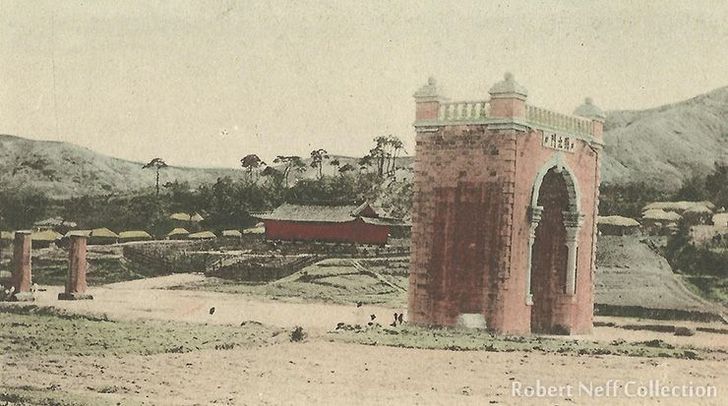
Independence Gate circa 1900
By Robert Neff
In the spring of 1895, following China's defeat by the Japanese during the 1894-95 Sino-Japanese War, Yeongeunmun (the Welcoming Gate of Obligation), where emissaries from China were met, was torn down to reinforce Joseon's complete independence. Only two pillars of the gate were left standing as a testimony to the past.
In June 1896, Homer Hulbert, editor of the Korean Repository, declared King Gojong had decided to replace Yeongeunmun with a new gate that would be known as Dongnimmun (Independence Gate). “We rejoice at this decision of His Majesty,” Hulbert wrote. “Let the Arch be erected and may the real independence of this country be placed on as firm a foundation as are the side pillars of the arch.”
But was the Korean monarch responsible for its construction? On July 4, 1896, The Independent ― a Korean newspaper owned by Dr. Philip Jaisohn, a Korean-American ― published the following account:
“Thanks to the will of the God, Korea, after many suns (years) of serving as a vassal state of the Qing Dynasty, has become a fully independent nation. Now, the monarch of Korea is on equal footing with the world's leaders, and the Korean people are free. Because of the significance of this auspicious event, this symbol will serve as a reminder to the world and to future generations of Koreans of Korea's everlasting independence as well as be a place where the Korean public can exercise and enjoy the fresh air, quiet, and scenery.”
Independent Gate circa 1900-1910
Throughout the summer of 1896, contributions by Koreans and foreigners were received almost daily and soon the estimated $4,000 needed for the construction of Independence Gate was raised.
The groundbreaking ceremony was held Nov. 21 and was well-attended by the residents of Seoul. One American guest described the event in her diary:
“All things went off beautifully ― some good speeches, the Governor of Seoul, a very intimate friend of ours, made a good speech in Corean and at the last, near the close, Dr. Jaisohn made in English a splendid speech 'Foreigners in Corea,' which we all listened to eagerly. Then he turned and made an address in Corean to the natives about the same thing. Then singing by the school boys and some very good drilling too, and then we all gathered nearby to a large building, where a long table was filled with splendid [food] and we were all waited on by the 'rank' and they seemed very proud to do it.”
It was “a good clear morning” she declared and professed she had never enjoyed herself more than she had at the event.
The gate was officially opened on Nov. 20, 1897 ― almost exactly a year after the groundbreaking ceremony. Nearly 1,850 pieces of granite were used and, somewhat ironically, part of the construction crew was made up of Chinese workmen.
Seoul Independence Arch circa 1905-1910