Poetry enriches patients' lives
By Kim Bo-eun
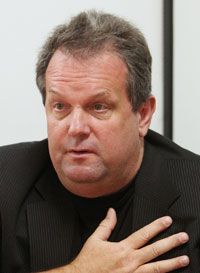
Gary Glazner, head of Alzheimer’s Poetry Project, a program using poetry for creative therapy sessions, speaks during an interview with The Korea Times at the Korea Arts and Culture Education Service (KACES) building in southwestern Seoul, Nov 1. Glazner visited Seoul for a workshop held from Oct. 31 to Nov. 1 at which he shared the techniques used in his program. Courtesy of KACES
The aim is to enhance the quality of patients’ lives, rather than focus on restoring their memories, said Gary Glazner, head of the Alzheimer’s Poetry Project.
“Dementia patients tend to become isolated as they speak and interact less with others,” said Glazner, during an interview with The Korea Times.
“And life as a dementia patient can be very stressful, as family members continue to ask them if they can remember things,” he added.
“The poetry sessions are about engaging these patients in creative activities where they can laugh and be playful,” said the American poet, who has been working with dementia patients for some 10 years in the United States. Alzheimer’s is a common form of dementia.
The sessions utilize basic techniques such as the “call and response” method. The artist leading the session recites a verse of a poem, and participants repeat it. Glazner was in Seoul for a workshop held from Oct. 31 to Nov. 1 hosted by the Korea Arts and Culture Education Service at which he introduced this technique, among others, to Korean artists.
According to him, a study conducted in 2004 in Germany showed that this method reduces stress levels for the patient. “Since they are only repeating what they’ve heard, it does not require much effort,” he said.
And as the selected poems are well-known ones which people learnt as children and in general are familiar with, the patients are able join in with ease.
“I had a patient that hardly spoke light up and blurt out the next verses when we were reciting some lines,” said Glazner. “It’s really great to see patients responding to the activities.”
Diverse methods are used spontaneously such as asking questions about the subject matter of the poem and exploring it through the senses. The sessions also incorporate music, singing and dancing to enrich the experience of participatory art.
“For example, once we were having a session at a museum where patients were looking at a live image of jellyfish swimming in the sea. We were dancing together, making movements like jellyfish, and also singing along to a well-known song about the sea,” he said.
Glazner, who studied poetry, started work in this field when he received a grant from a literary group to work with dementia patients in 1997.
What began without any structure developed into the Alzheimer’s Poetry Project, which now has programming in 23 states in the U.S, with funding from the federal government. It has also been introduced to countries such as Germany and Poland and some 15,000 patients have participated in the program so far.
Glazner hopes that the techniques can be used in Korea, to reach out to the dementia patients here. “I hope that the project can provide patients around the world with a better quality of life,” he said.
The workshop is part of a series organized by the Korea Arts and Culture Education Service under the Ministry of Culture, Sports and Tourism which invites art experts from abroad, to promote arts and culture activities in the nation.