'High-tech sweatshop' in spotlight
Book untangles structural causes of long work hours
By Kang Aa-young
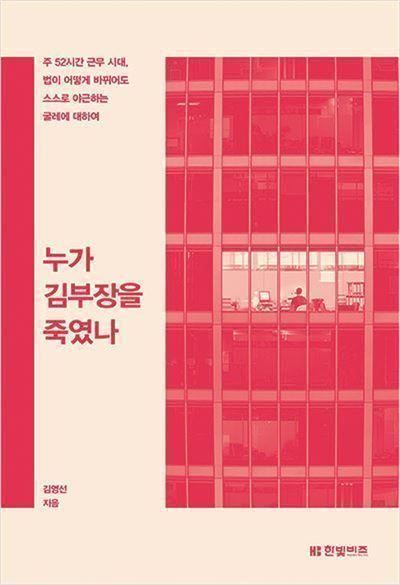
"Who Killed Mr. Kim?"
A self-employed worker identified only by his surname Jung has firsthand experience with the tragic consequences of inhumanely long work hours.
He saw his coworker die after years of hard work without proper rest.
His coworker was last seen alive four years ago at Jung's former workplace, one of the nation's largest companies.
Before leaving at the end of the day, Jung saw his coworker dozing off at his desk. He thought it was odd because he had never seen him sleeping like that at work.
His coworker was a diligent man who worked late nights all the time. His eyes were bloodshot. Despite hard work and long work hours, the man never got promoted. Arriving at work the next day, Jung was struck by a sense of urgency.
He saw ambulances surrounding the company building along with a host of cops and reporters. The man was found dead. He was the victim of what the media called a “sudden death.”
“He died from overworking,” Jung told The Korea Times. “I thought it could happen to any of us.”
His coworker's death caused him to seriously ponder a career transition. Jung quit and started his own business.
Kim Young-seon, a sociologist and the author of the new book “Who Killed Mr. Kim?,” said some Koreans wrestle with chronic fatigue because of sweatshop-like working conditions which are prevailing particularly in the game industry.
Engineers there cannot dream of quality of life, he said.
“People in the industry call their workplaces sweatshops and identify themselves as high-tech laborers because long work hours without proper rest happen there,” the author said in the book. “Game developers are all too familiar with long work hours. Some of my interviewees said management tries to squeeze engineers to force them to work overnight at the risk of their health and quality of life.”
Kim quoted an unnamed engineer he had interviewed for the book project as saying engineers in the game industry are exposed to inhumane working conditions.
“When I worked on the six-month project, I went to my office on Monday and was stuck there without leaving. I was in my office until Saturday. The situation went from bad to worse when I worked on a nine-month project. I worked 100 hours per week for nine months,” the interviewee said. “Some of my coworkers rented single-room housing and slept there together after work. This happens in this industry. Everybody suffers from sleep deprivation. So it's natural that they are not motivated. Sick and tired of inhumane working conditions, they had no hope for the future.”
South Koreans have the third-longest working hours among the member countries of the OECD, following Mexicans and Costa Ricans. An average Korean worker works over 2,000 hours annually.
They worked 660 more hours a year than German workers.
Author Kim called Koreans' long work hours “suicidal,” and said abusive corporate work culture constitutes violence. “Abusive working conditions are violence because it hurts people and their relationships with their family and friends. People are unable to dream of a better future or speak about happiness under such a situation,” he said.
Earlier this year, the National Assembly introduced a law to cut the workweek from 68 hours to 52 hours to give workers more free time and help them strike a work-life balance.
The Moon Jae-in government is implementing the shortened workweek, starting at companies with 300 or more employees.
Rosy predictions prevail. Some experts say industries related to leisure, culture and sports will benefit from the shortened workweek as people will spend more time making themselves happier.
Earlier this month, Culture Minister Do Jong-hwan met baseball spectators at the Hanwha Eagles Baseball Stadium in Daejeon on July 25 to listen to their opinions about the amendment.
The minister said the shortened workweek will help increase labor productivity and workers will be able to have a better quality of life if they make the most of the extra time for their own wellbeing. He hoped that professional sports can play a role to help the public enjoy their time off.
But author Kim remains skeptical about the impact of a shortened workweek on quality of life.
He said some workers won't be able to benefit from the amendment, noting in Korea the issue of long work hours is structural.