Book debunks 'fake news' about India
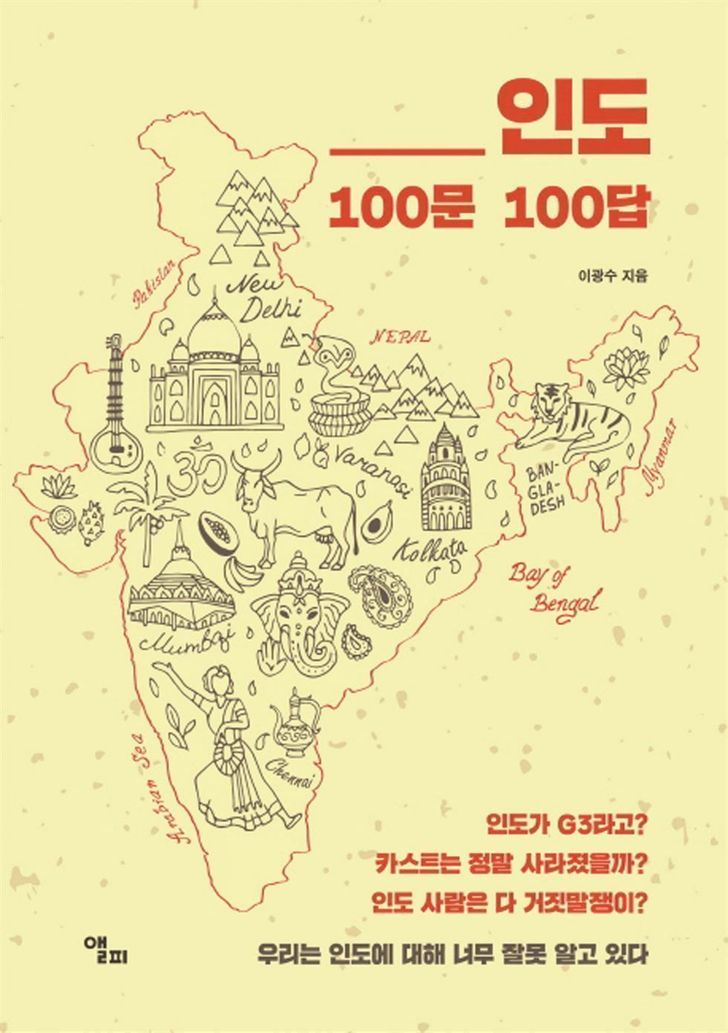
Cover of “India, 100 Questions and 100 Answers” by Lee Kwang-su
'India, 100 Questions and 100 Answers' corrects misconceptions about the country
By Jin Yu-young
How do we know what we know about India is correct?
Lee Kwang-su, author of the new book “India, 100 Questions and 100 Answers,” claims there are plenty of misunderstandings about the Southeast Asian country and this encouraged him to work on the book to educate the public.
“It is not that people have little knowledge of India, but rather, that they are misinformed,” said Lee, a professor of history at Busan University of Foreign Studies and an expert on India.
Lee said the book provides accurate information on the country and gives a detailed explanation of its history.
Lee Kwang-su / Courtesy of Lee Kwang-su
Each chapter covers a different facet of the country. Topics range from the characteristics of the Indian people to post-colonialism. Each chapter has subsections that further organize the book's contents. The title of each subsection is one of the 100 questions Lee addresses.
Answering common inquiries such as defining Hinduism, Lee also debunks many misconceptions and undermines certain prejudices held against its people.
In Chapter 1, the author mentions how many people view India as nothing more than an undeveloped country.
“But to do so,” he said, “is to be ignorant of India's unique characteristics.”
He describes India as a place where one must go “to find oneself” as India is a country that, unlike the rest of the world, both cherishes and rejects materialism as well as the standardized definitions of success.
Lee helps readers better understand the caste system, a hierarchal structure that categorizes the population into rigid social classes, and how it has changed throughout history.
Whereas in the past, a person's caste could be determined by their name or skin color among other things, in modern times many people have been able to rise above these labels through financial improvement and marriage.
After India's independence from England in 1947, the government has worked towards the desegregation of its people through creating anti-discrimination laws. There is still much progress to be made, however, as even though it may not be explicitly expressed, caste divisions run deep in India's history.
To make the book more relatable to Korean readers, Lee also ties in his experiences in India as a Korean person and addresses several questions Korean citizens may have.
One such example is his explanation of the absence of K-pop in India. He attributes a lack of TV and the internet to the inability of Korean pop culture to penetrate into the Indian market, as hallyu or the Korean wave is largely dependent on digital platforms. In another instance, Lee expresses his regret in how Korean companies fail to consider India in business transactions.
“India, 100 Questions and 100 Answers” is a helpful first step in better understanding India, a country that is sometimes considered difficult to approach due to its complex history and rich culture.
Lee successfully introduces the country to readers as a land of “unity in diversity,” or in other words, a country that is unique due to its many languages, religions and lifestyles.