Chung Mong-joon's vision as FIFA presidential candidate
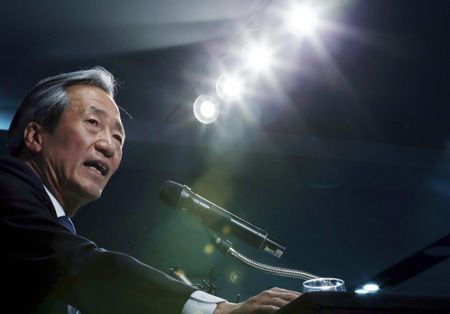
Chung Mong-joon, a former FIFA vice president, speaks during a press conference at the Korea Football Association headquarters in Seoul on June 3. / Korea Times file
My Challenge, My Passion’ traces tycoon’s journey in football community
By Nam Hyun-woo
Minutes before Chung Mong-joon, the former FIFA vice president, stood in front of reporters to drop the first hint of his bid for the presidency of the world football body two months ago, Chung’s aides hurriedly distributed a book written by the 63-year-old tycoon to the media there, saying it explained how well Chung understands FIFA.
Even before recent scandals tarnished the reputations of FIFA and its head Sepp Blatter, Chung, who served as FIFA vice president for 17 years from 1994 to 2011, hurled barbs at the two in his 2011 autobiography, “My Challenge, My Passion.”
As he stresses in the introduction to the book, “football taught me the how the world works,” Chung spends a sizable part of this 319-page memoir explaining how he got involved in the sport, why he is at odds with Blatter, and how he contributed to Korea’s co-hosting of the 2002 World Cup, as well as offering some glimpses into the secret politics of football.
After making his bid for the FIFA presidency public, Chung now uses harsher words to describe the Swiss national -- “a cannibal eating his parents and then crying he is an orphan.” His grounds for criticism are explained in a more detailed manner in this book.
In the book, Chung first writes about the legal battle between FIFA and MasterCard over a World Cup credit card sponsorship deal after the 2006 event. The credit card company had have been a key sponsor for the big sporting competition and had the right of first refusal for future sponsorships. FIFA, however, reneged on this and signed an eight-year deal with MasterCard’s archrival Visa. In April 2006, the company filed a suit in a U.S. court and six months later the judge ordered FIFA to cancel its deal with Visa and the legal battle came to an end when FIFA paid almost $100 million to MasterCard in June 2007.
U.S. District Judge Loretta Preska, who was in charge of the case, brought to light that FIFA officials had repeatedly lied to both card issuers during the negotiations _ she recited the phrase “FIFA lied” 13 times in her ruling.
After the conclusion, Blatter sacked then-FIFA marketing director Jerome Valcke and three others for lying to him -- which Chung criticized as “a bid to blame everybody except for himself” -- but appointed Valcke as FIFA Secretary General six months later.
Chung wrote, “The case tainted FIFA’s credibility. The judge said ‘FIFA's slogan is fair play, but its dealing with long-standing partner MasterCard constitutes the opposite of fair play,’ which was a huge humiliation to the organization, so I had to take some measures for its honor.”
Chung noted that he thought the case would be discussed at the June 2007 FIFA Executive Committee meeting, but no members came up with the issue, which he claimed was “in part because of pressure.” Blatter only briefly mentioned the case, saying that it was “smoothly settled.”
“For Blatter, the case was smoothly settled because he has awarded the sponsorship deal to Visa, whose chairman is his friend, and his close associate Valcke got a promotion. However, from a football fan’s stance, FIFA suffered a $100 million loss and was humiliated in a New York court. This should not be tolerated,” Chung wrote, adding that he told the committee that FIFA should take measures to recover its disgraced reputation.
“The FIFA Executive Committee is established for the purpose of checks and balances to the president’s self-righteousness. However, Blatter stripped the committee of its s power to nullify arguments against him, a move that many dictators have enjoyed in history.”
Hosting 2002 World Cup
In addition to being a key figure in world football's governing body, Chung also served as Korea Football Association (KFA) president for 16 years from 1993. However, he confessed that his favorite sport was boxing and he “somewhat coincidentally” took the top job in domestic football, but ended up accomplishing one of the biggest feats in Korean football history -- hosting the 2002 World Cup with Japan.
Chung took the job to fill the vacancy of his predecessor Kim Woo-choong, founder of the now-defunct Daewoo Group, and found an “abandoned” plan about hosting the 2002 event during the takeover.
“Back then, everything in this country was compared to that of Japan,” Chung recalled. “Should Korea fail to enter the race to host the 2002 event and allow Japan’s hosting, it was clear that Korean football would go backward to a status it would be unable to recover from.”
Chung recalled that not only international but also domestic comment over the bid was hostile, with palpable rumors that “Japan is (unofficially) chosen to host the World Cup.”
In order to “break into” FIFA, Chung started to visit all member countries of the Asian Football Confederation except for Japan and North Korea starting January 1994 in an attempt to garner support and managed to win the election for the FIFA vice president position representing Asia in May of the same year.
Then-FIFA President Joao Havelange was leaning toward Japan, as well as violently objecting to a co-hosting of the event, but the Union of European Football Associations supported the split, which Chung thought of as a second option for Korea.
On May 31 1994, Korea and Japan were chosen unanimously in preference to another bidder Mexico. This was the first -- and so far the only -- World Cup to be co-hosted by two countries. In the book, Chung specifies domestic and international challenges he faced during the process and political work he did to get other FIFA members’ support.
Other parts of the book are filled with a retrospective of his younger days: the successful inheritance of the Hyundai Group, life as a seven-term lawmaker and his botched attempt to become the nation’s president.
However, these stories seem to be distant from the sentiment of ordinary people who are not born with silver spoons in their mouth. The story of becoming the head of Hyundai Heavy Industries, once the world’s biggest shipbuilder, at the age of 30 is not likely to happen to everybody.
Rather, the story of Chung stepping into the world football community, which was relatively unknown to Koreans, and emerging as a big shot is dramatic and could provide a glimpse for those who want to become a sports diplomat.