Good writing is intelligent and economic
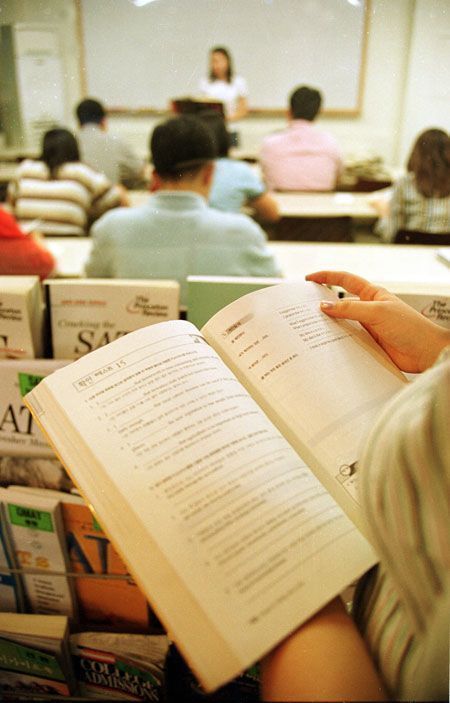
Korean students and office workers spend an enormous amount of time and money to improve their English skills, but not all of their education has been effective. / Korea Times photo by Im Jae-beom
"How to Write Concisely," Lee Chang-sup, Hannarae Plus
By Jung Min-ho
Defining what great writing is will always be a difficult subject because there are so many standards.
With an increasing demand for short articles in the fast-changing 21st century, however, there seems to be a demand for concise writing in almost every form. And that is what the book, “How to Write Concisely” by The Korea Times Executive Managing Director Lee Chang-sup, is all about.
“The longer writing gets, the obscurer a message becomes,” Lee wrote. “Writing can be described as a sculpture that becomes art after carving and polishing processes.”
Concise writing is only possible when the writer fully understands a subject matter, he added. If the writer fails to grasp the concept, the writing comes out in a complicated form.
In essence, keeping it simple, avoiding redundancies and picking proper words are the core messages of the book.
The 299-page book starts off with David Roosth’s application essay that impressed Yale University faculties only with 79 words over most others written about 800 words.
“Concise sentences, logic and message are much more persuasive than the longer ones,” Lee wrote.
The second chapter, “Removing unnecessary words,” and the third, “Drills for concise English,” demonstrate well the author’s philosophy in writing. The tips such as replacing “in the near future” with “soon” and removing “old” before “adage” are indeed effective in fixing wordy sentences that distract readers’ attention rather than grab it. Especially for those who consider careers in writing, the book is a great guideline on what to learn and avoid.
The two chapters show many wordy phrases creep into writing with examples, and provide explanations of how to shorten and delete them with shorter alternatives. And they really work.
Because of the author’s 30-year career in English journalism, the book is more for non-fiction writers than creative ones. Readers can see the trace of his background throughout the book especially in parts where he stresses the importance of objectivity, fairness and accuracy. In fact, these apply to almost all forms of non-fiction writings.
Perhaps the most practical tips for all readers are in the chapter 10 where they can learn about how to convey messages effectively via email.
“If you thought people would read your Email, just like newspaper articles, from beginning to the end, you are wrong,” Lee wrote. “Put the most important facts to the fore to make the readers understand and keep their attention.”
Although the book is very insightful and informative, there still is room for argument.
For example, the author says “avoid passive voice in principle” because active voice makes sentences clear and vibrant. This is generally true. But if a writer wants to emphasize the subject’s lack of control or a sense of mystery, using passive voice is a more proper way to express it, although such ways are barely used in journalistic writing.
With his first book, “How to Read The Korea Times,” his second book is a great resource for all professional and non-professional writers in terms of learning practical skills and knowledge.
The author wrote the aim of the book is to teach “fat-free” writing. But with other useful tips on how to pick credible sources and organize paragraphs, the readers can learn much more than just that.