The life and mind of a strongman
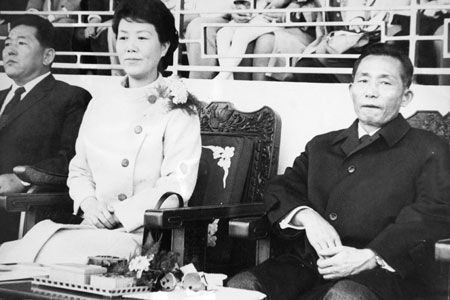
Late former President Park Chung-hee, right, watches a regional World Cup qualifying match with his late wife Yuk Young-soo in Seoul in 1969. / Korea Times file
“Park Chung-hee: From Poverty to Power,” Lee Chong-sik, KHU Press
By Kim Young-jin
Presidential inaugurations, more than any other political event in a democracy, embody a new moment for a nation as it turns a page and assesses challenges ahead.
This will hold true for Park Geun-hye, who on Monday takes office as the first female president in a country grappling with gender inequality, not to mention a stagnating growth outlook and saber-rattling northern neighbor.
But as Park takes over Cheong Wa Dae, the country will inevitably look to its past — in particular the regime of Park’s father, the late dictator Park Chung-hee, who while ruling the country with an iron fist from 1961 to 1979, oversaw its meteoric economic rise.
It is no secret that Park remains one the most contentious figures in Korea’s divided body politic. Less known, however, is much about the man himself and what stimulated his overthrowing of an incipient democratic government or his modernization policy. A lack of English language materials on the subject doesn’t help.
Prominent Korean-American scholar Lee Chong-sik’s book, “Park Chung-hee: From Poverty to Power,” released last year, offers a timely look into the events that shaped the elder Park’s worldview, from his poverty-stricken childhood to his controversial involvement with the Japanese military. While this naturally reveals nothing about the new Park administration, it provides fascinating insight into her lineage.
Presenting a balanced view on the subject is no easy task given the ideological divide. Supporters, many from the senior demographic that voted overwhelmingly in favor of Park Geun-hye, recall his role in nurturing domestic conglomerates that later shot to world prominence. Detractors say the country was primed for economic growth anyway, and that his heavy-handedness slowed development.
Lee is particularly interested in probing statements made by Park after the coup in which he denounced “all leaders of the past” for allowing the country to fall into a shambles of corruption and political intrigue, and vowing to “set ablaze” that past.
To do so, he charts Park’s journey from his early days in Gumi, North Gyeongsang Province to his time at the Japanese military academy and in Manchuria. He posits that that Park was driven to improve the country’s dire economic state out of a sense of injustice over his own poor upbringing.
“It was Park’s disgust and indignation against Korea’s past that pushed him through elementary school to his success as a child ... (His) goal was not only to undo the wrongs of the past but also to transform the national character that the old regimes had fostered,” he wrote. “The germ of Park’s anger ... was planted very early in his life.”
The book’s strength — it’s dedicated focus on Park’s mind — can also be seen as its limitation. Immense attention is paid to the details of Park’s upbringing, and while this is a welcome portrait, it prevents the book from delving deeper into his actions while leader, some of which remain unpopular to this day.
Lee argues that the involvement of Park’s father in the Donghak reform movement of the late 19th century played a role in shaping this internal drive, as the father was punished by his clan for the activism, leading to the family’s difficult economic situation. A childhood fixation with Napoleon also spurred the leadership style, Lee says.
Most interesting, though, is a thorough account of Park’s military career under the Japanese, an experience that, while giving him a wider perspective on the world, became a source of controversy down the road.
This is a sensitive topic given deep tensions between Korea and Japan over historical issues and because many Koreans believe Tokyo has not properly repented for rights abuses that occurred during the Japanese occupation from 1910 to 1945.
Lee, who also lived through the occupation and in Manchuria, makes educated guesses about Park’s mindset based on extensive research. Although what was actually on Park’s mind cannot be confirmed besides what the man himself left behind, the conclusions that Lee draws make the book accessible and compelling.
While the emphasis on mindset prevents the book from becoming the essential volume on the entirety of Park’s life, Lee’s efforts to unveil one of the nation’s controversial figures make for a valuable work.