Behind lens: vivid portrayals of humans
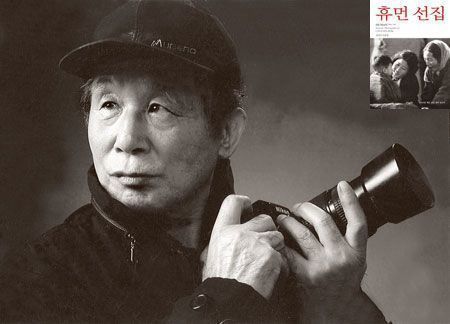
Photographer Choi Min-shik releases his pictorial anthology “Human.”
By Chung Ah-young
Photographer Choi Min-shik’s memorable shots have a raw vividness that jumps out from photos or sucks viewers into them with their emotional depth.
The 85-year-old veteran photographer, who has been taking pictures for more than five decades, has his lenses permanently aimed at people and awaits the brutally honest moment when life shapes faces in sadness, fear, pride, frustration or happiness.
Choi’s pictorial anthology, “Human: Selected Photographs of Choi Min-shik” (Noonbit Publishing; 592 pp. 29,000 won), revisits his illustrious career with his signature black-and-white photos that predominantly capture the lives of the working class and underprivileged. Choi describes the photos, part of his “Human” series that started in 1968, with his own words that reveal a dedication to realism.
The photos are also critical historical material showing Koreans’ lives from the 1960s to the 1980s, when the military governments pushed an aggressive growth strategy that produced a magnitude of social changes.
Choi’s main interest was with the people whose lives moved at a slower pace amid the rapid process of industrialization. In this book, his early works feature women working in Jagalchi Fish Market in the southern port city of Busan. The later works capture various images of people in other countries such as India and Tibet, which are later expressed in a more cheerful mode.
Photos taken by Choi Min-shik in Busan in 1965. Courtesy of Choi Min-shik and Noonbit Publishing
“My eyes are always fixated on the lower place. Joy, anger, sorrow and pleasure coexist in my black-and-white photos. The images of the poor who are the main models of my photos are so warm-hearted. As a realist photographer, I couldn’t have looked away from them,” Choi writes in the book.
Among others, many of his photos portray children on the streets worn out by hunger and poverty in the 1950 to ’70s. The images of children eating something with tears or smiles tell the truth more vividly than any words.
“Humans are the only beings who can share others’ suffering together. If nobody cares, there is no hope,” he writes. “I decided to leave the historical records behind for future generations to show what our society was like while working on my job ... A valuable photo has an enormous power to awaken society. The center of my work is always humans.”
He puts more emphasis on documentary values rather than aesthetic ones, believing that records of the truth can be a historical asset.
“The most important goal of photography is to contribute to social development. Solving social problems through the images is its goal. Photo realism and cynicism are the most appropriate media for contributing to social development,” he said.
On that score, he strongly criticizes the current trend of Korean photography which heavily relies on aesthetic values rather than realistic approaches. He reproaches that Korean photography has turned a blind eye to social affairs and ideology by focusing on “meaningless” images without any documentary spirit.
“The photographers should not only portray beautiful and lovely images but also ugly, hateful and critical images,” he said. “Behind the great photos are humanism and philanthropy. The photographers should perceive what reality is and what is right when translating them into visual images.”
He believes that the photos should capture living beings not ideas. Creating the photos should continue as part of a witness of time, he said.
Choi’s first and foremost principle is to capture real and true images without artificial techniques. He got shots which could never be replicated. “As time goes by, the moments began changing into history. And I was an ambitious young man taking photos here and there, but now have become an 80-something old man.”
He began his career after being inspired by the collection of “The Family of Man” by American photographer Edward Steichen (1879-1973) in 1955 when he was 28. He realized that the critical moments captured by the photographer can reveal more truth than words. Eugene Smith (1918-1978) was also a catalyst which encouraged him to harbor deep affection toward the art with his dark and strong colors focusing on humanism.
“Genuine photography is not portraying beauty but revealing the truth of life. I have never forgotten asking myself about why do I take photos for over the last 50 years. I was tempted to use my job for commercial purposes but I didn’t because I have always grappled with such a question,” he said.
“I couldn’t take my eyes off anywhere as a realist photographer ― whether it’s dark or remote. The place where humans are, there is my workplace,” he said.