Recent books
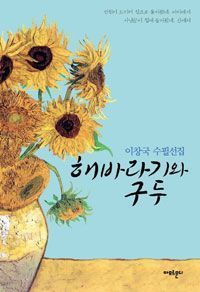
Sunflowers and Shoes
Lee Chang-kook; Amormundi: 352 pp., 15,000 won
There was a time when literary essays became popular in Korea because of the writings of the late celebrated writer Pi Chun-deuk, but recently it is difficult to find such works in bookstores.
However, this collection consists of 50 essays by Lee Chang-kook and casts fresh light on Pi. Lee was one of his pupils and has been a prolific writer over the last 30 years.
As Pi once said, essays are beautiful writings that are not glamorous or brilliant but make readers smile.
Lee’s pieces are written in a free style without flamboyant techniques but plainly portray trivial aspects of life in a hilarious tone.
The author touches upon various topics writing on the old typewriter he was fond of before he changed to a computer. He shares his thoughts on how to cope with heat in summer and cold in winter and his habit of frequently losing umbrellas.
His articles are rich in humor and wit and contain seasoned experience and insights.
― Chung Ah-young
A Light Inside
Jeannie Suk; translated from English into Korean by Song Yeon-soo; Book House: 272 pp., 14,000 won
Jeannie Suk, a professor of Law at Harvard Law School, talks about her life in this essay, from when she dreamed of being a ballerina in her youth to how she became the first Asian American woman to hold tenure at Harvard Law School.
Suk left for the U.S. with her family in 1979 when she was 6-years-old. As a student of Hunter College High school, she also attended the School of American Ballet and Julliard Pre-College for piano. She yielded to her parents’ wishes and gave up ballet. Based on her experience she emphasizes that “parents should just let their children make their own decision about their future.”
After obtaining a bachelor’s degree in French literature at Yale University and a doctoral degree in philosophy at Oxford University, she earned a J.D. from Harvard Law School, being fascinated with law. The professor also talks about becoming who she is today because she has always tried to find something to strive for, and that is why she became a Harvard professor.
In her first piece for Korean readers, she says if there is anything that makes you uncomfortable, you have to strive to leap over the hurdle.
― Baek Byung-yeul
Paul Smith: Notes
Paul Smith and Olivier Wicker; Translated from French into Korean by Kim Yi-seon; Artbooks: 196 pp., 20,000 won
British fashion designer Paul Smith, known for his classic yet witty creations, offers this book about his life and designs written with French magazine Obsession editor Olivier Wicker. The book is not just about the fashion world in which the designer is famous for his signature colorful stripes, but also touches on various aspects of Smith’s life.
At an exhibition in Korea titled “Inside Paul Smith” in 2010, the designer expressed gratitude to Korean readers in the preface. “I always loved visiting Korea. I got energy from the friendliness and positiveness of Korea ... I hope this book would convey the energy of creation to readers.”
The Smith’s world is revealed in alphabetical order, from Abbey Road and Jacques Anquetil to You and Zebra. Most of the photos, unless credited, are taken by the designer, showing where he finds inspiration and are included among many sketches, notes and scribbles that offer insight into Smith’s working process.
― Kwon Mee-yoo
No Matter How Hard I Try, Why Am I Going Nowhere?
Yi Kun-ho; Wiseberry: 344 pp., 13,000 won
People facing uncertainty in their career need professional advice to set the right goals. Author Yi Kun-ho is here to give the benefit of his 20 years of experience in strategic consulting in Korea.
In this his first book, he splits his ideas into four parts: how to cope with competition; how to deal with uncertainties; key elements in life strategy; and the qualities needed to become a strategist. Lee tells readers that the most difficult competition of all is dealing with uncertainty in life. A large number of people in Korea were made redundant after the 1997-98 financial crisis and after the global financial crisis in 2008, many ended up with huge debts. Since then, many people have been left with a feeling of great insecurity and uncertainty.
So the writer suggests people look ahead and prepare for possible scenarios so that they will at least be able to take more strategic actions.
― Rachel Lee