Recent Books
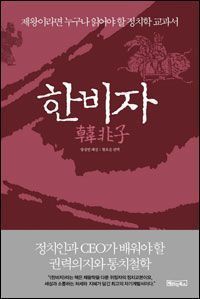
Han Feizi
Wang Gweng Bin; Translated from Chinese to Korean by Hwang Hyo-soon; Basic Books: 496 pp., 22,000 won
This book sheds light on the lesser known Chinese philosopher Han Fei and his monumental work “Han Feizi” that originated Legalism in the East around 200 B.C.
His work, which is both a compilation of his thoughts and a guide book for those in power for ruling, was the backbone to Confucianist politicos that shaped and controlled the 2,000 year long consecutive dynasties of the most influential country in Asia. The book offers snippets of his work as well as his life.
Han isn't considered equal in standing to Confucius and Mencius (whose Latinate names are a testament to their fame in both hemispheres), much like Socrates and Plato's predecessors to the two in the West.
But like his Western counterparts, his contribution is worth more than a side note in history.
Most readers will find him very similar to Machiavelli, but 1,500 years earlier and, in the same degree, ruthless. The book says that Han believed all people's actions were motivated by selfishness, even between parent and child, and rulers must borrow the force of law to hold on to power. Punish to keep power, but be generous to be loved, he says.
Later empires saw the consequences of Han's vision in the Qin Dynasty whose founder Qin Shi Huang unreservedly embraced the philosophers code: starting with the succeeding Han Dynasty, they would wisely pepper it with Confucius’ paternalism and moralism, while keeping the strict legal system hidden subtlety to maintain control in their empire building.
― Cho Mu-hyun
Chasing the Devil
Tim Butcher; Translated from English to Korean by Lim Jong-ki; Eidos: 358 pp., 16,000 won.
This is a long overdue Korean translation of a travelogue that confronts one of the most war-torn places in the world: Sierra Leone and Liberia of West Africa.
Accomplished journalist Butcher follows in the footsteps of British novelist Graham Greene, who commenced a dangerous tour of the sub-Saharan nations over 70 years ago.
He merges his travel accounts with his personal memories of his past in the two countries as a correspondent, that of Greene, the countries' devastating history and its contemporary situation.
The culmination of these is not a haphazard confusion of stories but a unified coherent narrative, achieved by the author's honesty and, more importantly, affection for the places he travels.
Readers will be intrigued and disturbed by first-hand accounts of chimpanzee sanctuaries, blood diamonds, drug-addicted child-soldiers and the extreme violence (genital mutilations, dismemberment and more), which the author rightly calls the devils of Africa.
The story he tells is extremely private at moments (Butcher talks of his feelings ― pride, fears and egoism ― unabashedly), but at the same time, his account will undeniably touch a general chord shared by people.
The book justifies German philosopher Frederic Nietzsche's claim that the most personal beliefs are sometimes the most universal.
His insight into Greene, that shows the novelist as both flawed and human instead of drawing up a hagiography, may also prove to have an additional benefit of motivating Korean students with embarrassingly low book-reading rates, to buy some novels.
I Leave for Seoul
Kwon Da-hyun; Readers House: 288 pp., 13,000 won
Seoul is a fascinating city for both tourists and residents. Travel writer Kwon Da-hyun sheds new light on the city from the perspective of a Seoulite looking for hidden gems. The author suggests a variety of ways to spend a night in Seoul, from "hanok" (Korean traditional house) guest houses and serviced residences to chic boutique hotels and luxury hotels, and tour courses based on accommodation.
“When you look at Seoul from a new angle, it’s a charming city. If you are on a business trip to Seoul, this book will guide you to the secrets of the city,” Kwon writes in the prologue of the book. She reviews each lodging thoroughly, including location, facilities, interiors and other characteristics.
Eugene House in Hyehwa-dong is filled with antique furniture thanks to the owner who collects them, while Yeonwoo House in Gahoe-dong offers great organic breakfast. Market M in Tongin-dong doubles as a showroom for namesake design company, so guests can use their products and furniture. Mama Guest House and Happy Garden Guest House are located at the foot of Mt. Nam and close to tourist spots such as Myeong-dong and Namdaemun Market.
― Kwon Mee-yoo
Tea Sommelier Guide
Francois-Xavier Delmas, Mathis Minet and Christine Barbaste; Translated from French into Korean by the Korea Tea Sommelier Institute; the Korea Tea Sommelier Institute: 190pp., 18,000 won
A tea sommelier is an expert who understands the alchemy of brewing a great cup of tea. The Korea Tea Sommelier Institute, which offers tea sommelier training courses, has brought its version of the ultimate tea guide written by three well-known French tea sommeliers ― Francois-Xavier Delmas, Mathis Minet and Christine Barbaste.
The Korean version of “Tea Sommelier Guide” is designed for those who are interested in tea in general and wish to learn more about it. This A to Z book comprises two parts. The first gives a brief history of tea and the ideal environmental conditions for tea cultivation, while introducing many different types of tea. The second focuses on tasting including the required kit and techniques for tea tasting.
― Rachel Lee