Often found at theaters and museums, Kwon Mee-yoo has covered a wide range of cultural fields from K-pop and dramas to theater and fine art for over a decade. Now as K-Culture Desk editor, she tries to connect Korean culture with global readers through fresh perspectives.
Performing arts industry takes blow from strengthened social distancing in peak season
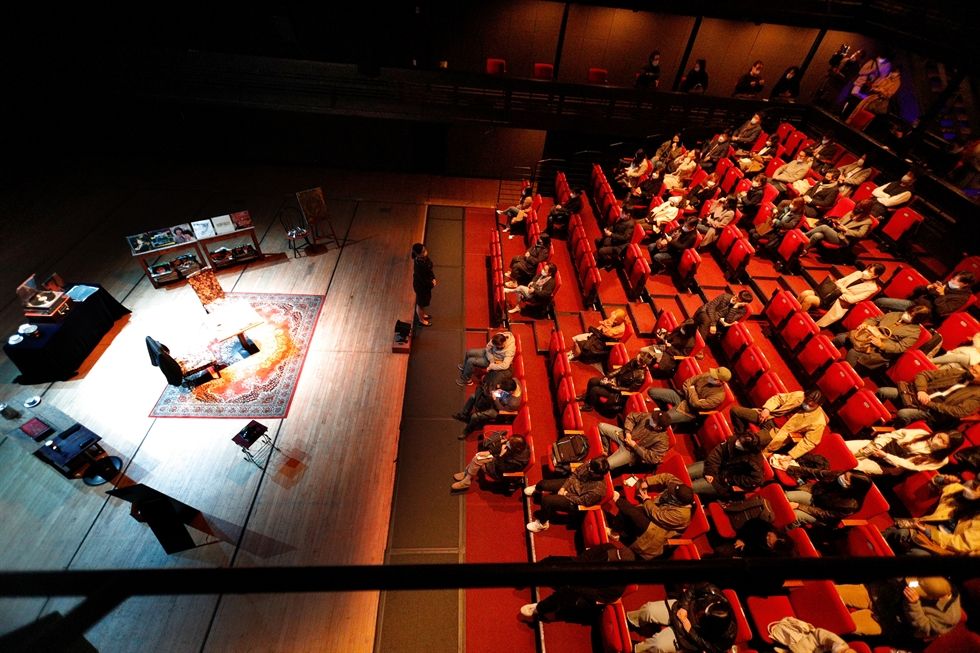
Social distancing seating at Jayu Theater, Seoul Arts Center / Courtesy of Seoul Arts Center
By Kwon Mee-yoo
By Kwon Mee-yoo
The year's end is typically a big season for the theater industry, but the COVID-19 pandemic has marred this year's mood as the resurgence of infections has seen the tightening of social distancing rules, delivering a blow to theaters.
With COVID-19 infections spiking, and the Seoul Metropolitan Government and the Korea Disease Control and Prevention Agency raising the alert level in early December, the Korea Performing Arts Box Office Information System (KOPIS) announced that the number of theatrical tickets sold so far this year was 66,000, approximately one fourth of the corresponding period last year of 1.1 million.
The number is likely to drop further as most shows have been halted for three weeks to comply with the government's effort to control the spike in COVID-19 infections.
According to the newly imposed five-tier social distancing scheme, starting from level 1.5, theaters must leave one seat empty after every two occupied seats to prevent the spread of COVID-19. At level 2, it is one empty seat after one occupied seat and at level 2.5 two empty seats between each occupied seat. At the highest level 3, theaters must go into lockdown as well as most other facilities.
Korea's theater industry faced COVID-19 crises in April and August as infections surged. However, this is the first time for most shows to shut down for three weeks, regardless of their theater size, despite being the high season.
Large scale musicals "Ghost," "A Gentleman's Guide to Love and Murder" and "The Count of Monte Cristo" all announced closures through Dec. 28. The highly anticipated production of "Man of La Mancha," which was slated for a Dec. 18 opening, postponed this until January.
Most of the smaller productions in Seoul's theater district of Daehangno also said their performances will be halted for around three weeks.
"We decided to temporarily suspend our performances to cooperate with the government's efforts to prevent COVID-19. However, the administration has put performing art companies into a situation where we have to stop losing money while staging shows," an official of a musical production company said.
"Seoul City already reduced public transportation services after 9 p.m. and our show ends around 10:30 p.m., which makes returning home difficult for our customers. So we made an early decision to close down the show for three weeks."
The official said it was practically impossible to hold a performance with Level 2.5 social distancing regulations.
"If we have two empty seats between each audience member, we can sell about 300 tickets in a 1,200-seat theater. And the 300 tickets do not always sell out. If you do the math, you can easily tell that it is impossible to operate a show under the circumstances. Moreover, we do not get back our theater rental fee even if we stop or operate at a reduced capacity," the official said.
During the COVID-19 pandemic, Korea has been regarded highly for maintaining theatrical performances. Not a single case of infection within theaters has been reported, even though several COVID-19 patients did watch live performances. Epidemiological investigators notify the visit of COVID-19 case to theaters and audiences on the day, but even those who sat close to the infected person are not classified as close contacts as everybody wears mask and looks ahead without speaking to each other.
The official also mentioned that there were some COVID-19 cases in theaters, but none of them were transmitted.
"We are doing our best to prevent epidemics in the theater; managing all people going in and out including audiences, actors and crew. However, people take public transportation together and eat together, so then sitting apart in theaters doesn't make sense. This social distancing seating plan doesn't seem effective, except for reducing density," the official said.
Some shows chose to continue despite the strengthened social distancing rules. The play "Old Wicked Song," staged at Yes24 Stage in Daehangno, went through ups and downs before opening Tuesday with only one third of the seats filled.
The show first sold two thirds of its seats in early November. In late November, due to the resurgence of COVID-19 infections, the social distancing level was raised to 2, which required theaters to have a vacant seat between audience members. The show had to cancel all sold tickets and people had to book their tickets again as the seating chart changed.
The government announced the raising of the social distancing level to 2.5 last weekend, and this mandates theaters to operate at only one third of their capacity, having two empty seats between customers. The show once again had to cancel its reservations as it sold more tickets than the newly regulated capacity.
"The social distancing level was raised just ahead of the show's opening. We were busy installing sets and rehearsing when we heard the news. After deliberation, we decided to continue with the show, following the government's guidelines," the play's PR official said.
"With only one third of seats available, sales fell way short of the break-even point. However, we made a promise to the audiences as well as the actors and crew so we will accept the damage and continue the show."
Theatergoers, who are supporting the faltering industry with loyalty, also feel fatigued about having their tickets canceled and then making reservations again as the seating plan changes according to the government's social distancing levels.
"I was able to book a seat when a show I wanted to watch first released tickets, but when they reopened with reduced seats, I was able to snatch a seat a few rows behind my original one. The booking competition gets fiercer as the number of available seats is reduced," an avid theatergoer who declined to be named said.
"Many of my December tickets have been canceled as most shows chose to cancel for three weeks. And for those who are still open at one third of original capacity, I am tired of vying for limited number of tickets.”
Kwon Mee-yoo