China signals end to hallyu ban as K-pop prepares for return
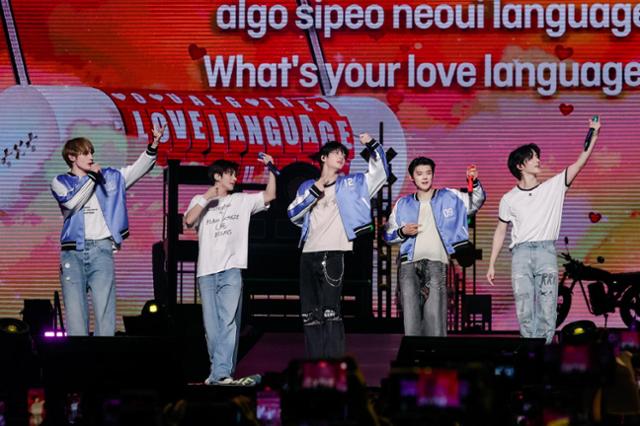
Tomorrow X Together (TXT) perform at Galaxy Arena, Macau’s largest indoor concert venue. Courtesy of BIGHIT Music
For nearly a decade, Korea’s entertainment industry has faced a long, dark tunnel when it comes to China. Now, however, a faint light appears to be emerging at the far end. China’s long-standing restrictions on Korean pop culture — commonly referred to as the hallyu or Korean wave, ban— are showing signs of gradually easing.
At Chinese music retailers, K-pop albums have returned to store shelves and are once again displayed prominently. On Chinese streaming platforms, a local remake of the Korean drama “My Mister” has been unveiled. The shift in atmosphere is even fueling cautious optimism about the possibility of a government-level K-pop concert backed by the Korean government in China — something that had previously failed to materialize.
The Hallyu ban effectively took hold in 2016, following Korea’s deployment of the U.S.-built Terminal High Altitude Area Defense (THAAD) missile defense system, which Beijing viewed as a threat to its security interests. Although the Chinese government never formally announced the measure, it functioned as a sweeping, unofficial ban on Korean music, television dramas and films, inflicting a severe blow on Korea’s entertainment industry.
K-pop artists, who were barred from holding concerts in China, were among those most severely affected. With live performances involving singing and choreography effectively prohibited, artists were largely cut off from China — a market that once accounted for a significant share of overseas revenue. For years, the industry has awaited a lifting of the ban.
Now, after nearly a decade marked by repeated cycles of false hope and disappointment, a genuine shift finally appears to be taking shape. The development comes about two months after signs of progress emerged during Chinese President Xi Jinping’s visit to Korea late last year, when he responded positively to a proposal to stage a large-scale performance in Beijing. The idea was put forward by Park Jin-young, co-chair of the Presidential Committee on Popular Culture Exchange, prompting Xi to summon China’s foreign minister and issue follow-up instructions.
The industry took the response as more than a diplomatic courtesy, interpreting it as a symbolic signal that change might be on the horizon. That assessment soon proved prescient, as Xi went on to make more direct remarks pointing to a potential end to the hallyu ban during his summit meeting with Korean President Lee Jae Myung this month.
Lee, during his visit to China, quoted Xi as saying, “Ice that froze over three feet does not melt all at once. Fruit ripens and falls when the time is right,” adding that the metaphor aptly captured China’s approach to the issue.
“That is how they intend to proceed,” Lee said, adding that a sudden and drastic reversal would only underscore the existence of the ban, which Beijing has long denied. “It’s something both sides need to understand.”
He forecast that the hallyu ban would be lifted gradually. With Xi known to have instructed relevant ministries to begin detailed discussions, speculation is growing that change could come sooner than previously anticipated.
Evidence of movement is already visible on the ground. The release of the Chinese remake of “My Mister” on Chinese streaming platform Youku is notable, as it marks the first Korean drama remake to be publicly distributed in China since the ban took effect. The Korean government is also reported to be exploring ways to expand the release of Korean films in China following recent bilateral summits. At music retail outlets, K-pop albums have begun to reappear in prominent front-of-store displays.
For the K-pop industry, these developments mark a potential inflection point. Over the past decade, K-pop has aggressively expanded into global markets, refining its production systems and cultivating a broad international fan base. A reopening of China — with its vast population and strong appetite for idol-driven content — could provide a powerful new engine for growth.
Artists who maintained sizable Chinese followings even during the freeze stand to benefit most, with expectations of expanded tour schedules and increased album sales. As the once-frozen market begins to thaw, attention is now focused on how far and how fast the easing will proceed — and whether it will usher in a new phase of expansion for K-pop on one of its most consequential stages.
This article from the Hankook Ilbo, the sister publication of The Korea Times, is translated by a generative AI system and edited by The Korea Times.