Allies to curb N. Korea coal exports
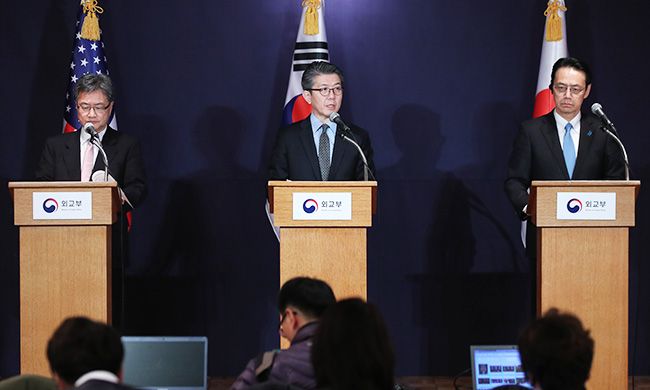
Kim Hong-kyun, center, special representative for Korean Peninsula Peace and Security Affairs at the Ministry of Foreign Affairs, speaks during a joint press conference with U.S. Special Representative for North Korea Policy Joseph Yun, left, and Japan’s Asian and Oceanian Affairs Bureau Director-General Kenji Kanasugi following their meeting at the Lotte Hotel in Sogong-dong, downtown Seoul, Tuesday. / Yonhap
By Yi Whan-woo
The top nuclear negotiators of South Korea, the United States and Japan agreed to cooperate in implementing the latest U.N. Security Council (UNSC) sanctions aimed at curbing North Korea’s coal earnings, Tuesday.
Following their three-way talks in Seoul, Kim Hong-kyun, the special representative for Korean Peninsula Peace and Security Affairs at the Ministry of Foreign Affairs, said the three allies agreed to “maintain a round-the-clock information-sharing system” to enforce a cap on Pyongyang’s coal exports under UNSC Resolution 2321.
Kim said he and U.S. Special Representative for North Korea Policy Joseph Yun and Japan’s Asian and Oceanian Affairs Bureau Director-General Kenji Kanasugi also vowed to carry out other diverse “money-blocking measures” against Pyongyang while verifying implementation of the UNSC resolution.
“We shared the view that it is more important than ever to keep close cooperation among the three countries,” Kim said. “We also agreed to fully prepare for all possibilities including the North’s additional provocations.”
Kim, Yun and Kanasugi met for the first time since the UNSC unanimously endorsed Resolution 2321 on Nov. 30 and the three allies took follow-up measures by introducing their own sanctions against the Kim Jong-un regime.
Resolution 2321 is designed to restrict North Korea’s annual export of coal to $400 million or 7.5 million tons, whichever is lower in value, in response to the military state’s fifth nuclear test carried out on Sept. 9.
Kim warned that North Korea’s nuclear ambitions will only lead to regime collapse and denuclearization is its only remaining option.
He said the door remains open for talks with the internationally isolated Pyongyang although denuclearization efforts should be a precondition for any dialogues.
Yun voiced a similar view. “Sanctions are a tool, not an end in themselves,” he said. “We have long made clear that we remain willing to engage in credible and serious denuclearization talks. Unfortunately the DPRK’s response with an escalation pattern of ballistic launches, nuclear tests and inflammatory rhetoric underscores that it is not ready.”
Yun reaffirmed the U.S.’s commitment to its allies to “remain ironclad.”
Concerning China, Yun said he hopes Chinese authorities cooperate in carrying out UNSC resolutions to block Pyongyang from earning hard currency to pursue its nuclear program.
China accounts for the majority of Pyongyang’s coal earnings and is seen as a key for the success of Resolution 2321.
Yun speculated that U.S policy on North Korea will remain consistent even under a Donald Trump administration, which will begin on Jan. 20.