NK rejects demand for nuke renunciation
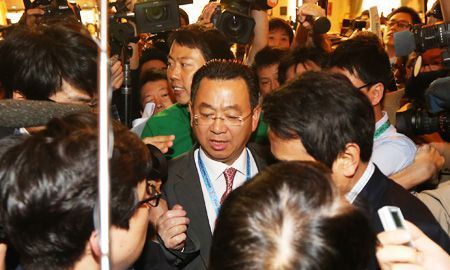
North Korean diplomat Choi Myung-nam, center, talks to reporters at the main venue of the ASEAN Regional Forum in Bbandar Seri Begawan, Brunei, Tuesday. / Yonhap
By Chung Min-uck
North Korea will stick to its nuclear weapons program unless the United States ends what it calls a “hostile” policy toward it, said North Korean Foreign Minister Pak Ui-chun, Tuesday.
“We won’t give up our nuclear programs unless the U.S. withdraws its hostile policy against our country,” Pak was quoted as saying by Choe Myung-nam, a senior official from the North’s foreign ministry, on the sidelines of the ASEAN Regional Forum (AFR) in Bandar Seri Begawan, Brunei.
Park also called for the U.S. to hold direct talks with Pyongyang unconditionally, ignoring Washington’s call to show sincerity regarding denuclearization.
“If the U.S. truly wants to achieve peace and stability on the Korean Peninsula, it should accept our offer of high-level talks without preconditions.”
Leaders of the long-stalled six-party talks aimed at ending North’s nuclear ambitions are demanding Pyongyang to abide by the Sept. 19, 2005, joint statement and give up its nuclear programs.
The top security forum in Asia was held for one day in Brunei.
“We are working to present a united front with five parties of the six-party talks — South Korea, the U.S., China, Japan and Russia — to keep up pressure on North Korea to abandon its nuclear weapons program,” said a Seoul delegate at the ARF.
Seoul is pushing for the ARF to adopt a chairman’s statement that includes the North’s commitment to the landmark Sept. 19 joint statement signed by the six-party nations.
In the 2005 joint statement, the North is obligated to abandon nuclear weapons and existing nuclear programs including returning to the Nuclear Non-proliferation Treaty which it withdrew from in 1994. The North conducted its first nuclear test the following year and the multi-way talks have been stalled since 2008.
U.S. Secretary of State John Kerry said Monday after holding bilateral talks with Chinese Foreign Minister Wang Yi that North Korea must “honor its commitments made under the Sept. 19, 2005 joint statement on six-party talks which refers very specifically to verifiable denuclearization.”
Chinese Foreign Minister Wang Yi was also quoted as saying by some Chinese media that Beijing also wants Pyongyang to comply with the 2005 commitment so that the six-party talks can resume soon.
Kerry further said that Washington, Beijing, Seoul and Tokyo are “absolutely united” in their efforts to convince the North.
“All four of us are absolutely united and absolutely firm in our insistence that the future with respect to North Korea must include denuclearization,” said Kerry in a press conference.
“China made it clear to me that they have made very firm statements and have taken very firm steps with respect to the implementation of that policy.”
Foreign Minister Yun Byung-se also downplayed North Korea’s recent dialogue offers as a “charm offensive,” insisting that any talks with the North are meaningless unless the communist country is serious about abandoning its nuclear program.
“Recently, North Korea suddenly started a charm offensive. South Korea has always been open to dialogue, but it will not have dialogue for the sake of dialogue itself,” Yun told the ASEAN Flus Three foreign ministers’ meeting on Sunday.
Minister Wang said Monday that he urged for North Korea to give up its nuclear weapons program, while calling for an early resumption of the six-party talks.
Wang made the remarks shortly after holding bilateral talks with North Korean Foreign Minister at a hotel on the sidelines of a regional security conference.
“Our unchangeable goal is the denuclearization of the Korean Peninsula, and we continue to make efforts to achieve this goal,” Wang told reporters.
Seoul and Washington have urged China to put more pressure on Pyongyang to give up its nuclear weapons program. However, Beijing, while agreeing to the call for denuclearization, has been reluctant to use its leverage over North Korea out of concern that pushing the communist regime too hard could hurt its national interests.
Meanwhile, in an effort to make a breakthrough in the situation, Kim Kye-gwan, North Korea’s chief nuclear envoy, left for Russia on Tuesday, according to the North Korean Central News Agency.
Kim is expected to hold talks with Russian deputy foreign ministers Vladimir Titov.
Kim visited Beijing last month for the same purpose.