US peace gesture presses NK to respond
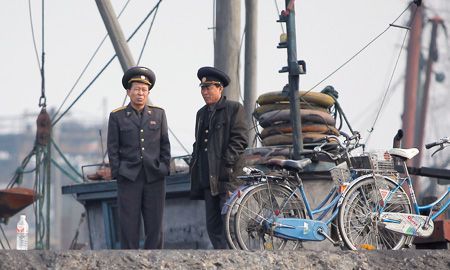
North Korean officials wait by the docks along the bank of the Amrok River (Yalu River) in the North Korean town of Sinuiju across from the Chinese city of Dandong, Thursday. / AFP-Yonhap
Pyongyang in big dilemma not to show weakness while pursuing nuclear status
By Chung Min-uck
Kurt Campbell, former U.S. assistant secretary of state for East Asian and Pacific affairs, speaks during a forum hosted by the Johns Hopkins School of Advanced International Studies in Washington, Thursday. He said there are clear signs of a subtle change in China’s approach toward North Korea, which may affect calculations on regional security conditions. / Yonhap
The United States has tried to cool its one-upmanship with North Korea.
Now it is up to Pyongyang whether to take this opportunity or press ahead with the game of chicken. The problem is the North may take the lull in the U.S. show of force as a sign of weakness.
The U.S. State Department, via its Spokeswoman Victoria Nuland, said Thursday the current shoring up of defense postures by both sides “does not need to get hotter” and that Washington “can change course” if Pyongyang comes back to compliance with its international obligation of denuclearization.
Observers perceived the words as the U.S. seeking a “diplomatic way out” of the confrontation.
U.S. Secretary of State John Kerry’s trip to Asia, slated for next week, aims to promote talks about finding a diplomatic breakthrough with its two allies ― South Korea and Japan ― and China, the only remaining ally to the isolated North, some sources say.
Experts here said such a move could bring a turnaround in the situation.
“With just a show of force, the U.S. cannot solve the problem surrounding North Korea,” said Korea University Professor Yoo Ho-yeol, Friday. “Delivering such a message, talks between Washington and Pyongyang could follow as North Korea also wants talks with U.S.”
Yoo, however, added such talks would take place only when the North withdraws from its nuclear projects. This is because the North has been trying to be accepted as a nuclear state at the risk of becoming further isolated.
“With no change in the North’s stance toward developing nuclear programs, there will not be a step forward,” he said.
Others doubted the U.S. statement would be effective.
“A U.S. message saying the door is still open for talks does not work with North Korea,” said Chang Yong-seok, a senior researcher at the Institute for Peace and Unification Studies at Seoul National University. “The North has made up its mind to keep raising tensions on the Korean Peninsula so such an unclear message is not a solution.”
The latest American military show of force came in response to ceaseless bellicose statements issued by North Korea,
The ongoing confrontational phase dates back to the North’s long-range rocket launch in December, followed by an underground nuclear test in February.
Those actions drew harsh international condemnation including tougher United Nations sanctions on the Stalinist regime. The sanctions, together with joint military exercises between U.S. and South Korea, prompted the Kim Jong-un regime to step up its war threats by unilaterally declaring the 1953 armistice agreement scrapped and severing the military hotline between the two Koreas.
Pyongyang also banned the entry of South Korean workers and goods to the inter-Korean joint industrial complex at Gaeseong.
The South Korean government also says it is open to engaging with North Korea any time it chooses to scrap its nuclear programs.
Politicians here, too, are showing bipartisan support to sending a special envoy to North Korea to make a breakthrough and relieve tension.