Japan's nuclear ambitions troublesome
By Kim Tae-gyu
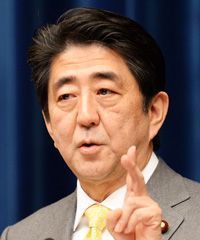
Shinzo Abe Japanese prime minister
Japan is causing concerns among its neighbors once again.
This time around, it is about the country’s plan to activate a reprocessing facility that will produce vast amounts of weapons-grade plutonium.
Constructed over several decades, the plant in Rokkasho on Japan’s Pacific coast will open this October, and Japanese leaders have confirmed that it will go into operation.
The Rokkasho facility has raised concerns about Japan’s real motives for operating it as many experts say it lacks commercial viability and has questionable security.
Japan claims that the Rokkasho site is merely for energy. But once it is running at full capacity, it will roll out some eight tons of plutonium every year, which observers say would be enough to build hundreds of nuclear warheads.
Seoul has expressed concerns about Tokyo’s move.
“Any state that produces and retains more nuclear material than is necessary will be subject to suspicions. It will also become vulnerable to outside threats, thus creating security problems for itself and its neighbors,” Foreign Minister Yun Byung-se said.
“The surplus nuclear material should be dealt with in consultation with the International Atomic Energy Agency and associated countries so that neighboring states don’t have to worry.”
The plant could also be one of the major points of discussion during the Nuclear Security Summit later this month in The Hague, observers said.
The Center for Public Integrity (CPI) also warned this week that the $22 billion facility may become a target for terrorism, and the U.S. is concerned about this.
“Publicly, the U.S. has said little about Japan’s plans to enlarge its existing stockpile of plutonium,” the CPI said.
“But since President Obama was elected, Washington has been furiously lobbying behind the scenes, trying to persuade Japanese officials that terrorists might regard the Rokkasho plant as an irresistible target.”
However, the official U.S. stance is that it is not concerned about the project and Japan’s large stockpiles of nuclear fuel.
Korea may regard this as a double-standard since Washington has completely forbidden reprocessing by Seoul.
“The U.S. has refused to allow Seoul to recycle its spent nuclear fuel, but lets Japan do so. It’s not easy to understand,” said Professor Shin Yul from Myongji University.
“This may become a very serious issue, which might end up generating anti-U.S. sentiment since Koreans are very offended by Japanese politicians’ controversial acts and remarks.”
Since Korea’s storage capacity for highly radioactive nuclear waste is running out fast, Seoul has tried to revamp the Korea-U.S. Atomic Energy Agreement to deal with it.
To deal with Washington’s suspicions on proliferation, Seoul came up with an alternative technology called “pyro-processing,” but this was rejected.
“I think that the U.S. is required to do something to grapple with the criticism of its approach, which could be understood as a double standard,” Shin said.