Anna Jiwon Park has been covering the politics at The Korea Times since the summer of 2024, when she joined the press pool for the Office of the President in Korea. Prior to that, she spent about five years reporting extensively on financial markets, regulatory authorities and the financial industry. She joined The Korea Times in 2019 after spending eight years as a broadcast journalist at Arirang TV, Korea’s leading global broadcaster, covering politics, defense and culture.
Presidential candidates vow to revamp capital market
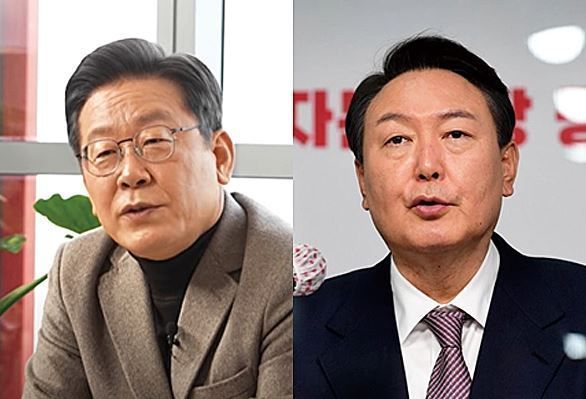
Ruling party presidential candidate Lee Jae-myung, left, speaks during his appearance on 3ProTV's YouTube channel aired on Dec. 25. Main opposition party presidential candidate Yoon Suk-yeol speaks during a press conference in Seoul, Monday. Yonhap
By Anna J. Park
By Anna J. Park
As the presidential election nears, rival candidates have each come up with their own election promises and views on how to improve local capital markets, aiming to attract votes from active retail investors.
The main opposition People Power Party's (PPP) presidential candidate Yoon Suk-yeol vowed to completely abolish the securities transaction tax by 2023. He made the comment during his capital market policy announcement held at PPP headquarters on Yeouido, Monday.
“Although one in five people in the country is participating in the local stock market, the stock markets haven't yet functioned properly to share listed companies' growth with retail shareholders,” Yoon said, adding that he pledges to focus on creating a fairer market system where the values of local companies are well-acknowledged, and both companies and investors can enjoy a win-win situation.
On top of the abolishment of the securities transaction tax in 2023, Yoon also vowed to lower a capital gains tax to be introduced in the local stock market the same year.
The conservative presidential candidate also vowed to reform the short-selling system, so that retail investors won't be put in an inferior position compared to foreign and institutional investors.
The former prosecutor-turned-politician also aims to strengthen sanctions on securities crimes, in order to raise transparency of accounting and public disclosures.
The ruling Democratic Party of Korea's presidential candidate Lee Jae-myung has also been stressing his willingness to strengthen the local capital market.
During his recent YouTube appearance on 3ProTV channel ― one of the most popular economic channels among local retail investors ― Lee said the nation's benchmark index KOSPI could easily rise above 4,500 points, if it overcomes the Korea discount ― the tendency to receive lower valuations compared to actual corporate value on stock markets. The index has long been trapped in a boxed range of somewhere around 3,000 points during the past year.
“While the country's weight in the global capital market is somewhat significant, the Korea discount is just too much. Achieving 5,000 points on the KOSPI shouldn't be that difficult,” Lee said during the YouTube appearance, uploaded on Dec. 25. “When it's compared to major global countries, the local stock market is just too undervalued. If it becomes normalized (from the Korea discount), the KOSPI could easily exceed 4,500 points,” Lee added.
Lee explained that he thinks the core reason behind the Korea discount is no longer about geopolitical concerns surrounding the Korean Peninsula, but now more about lack of market transparency.
“The rate of imposing sanctions on stock price manipulation is too low, and punishments are too weak. This created distrust of the market,” Lee said, vowing to severely punish any attempts at stock price manipulation.
The former Seongnam mayor also said the National Pension Service should increase the portion of domestic stocks in its investment portfolio, while stressing the short-selling system should be improved.