Park Jae-hyuk is a seasoned journalist who has provided comprehensive coverage of South Korea's corporate dynamics, economic policies, industry challenges and the global positioning of Korean companies. Based on the articles he has written since joining The Korea Times in 2016, his investigative approach has helped readers understand corporate governance, economic trends and business strategies shaping South Korea’s economy.
Experts back ruling party's proposal to delay crypto tax
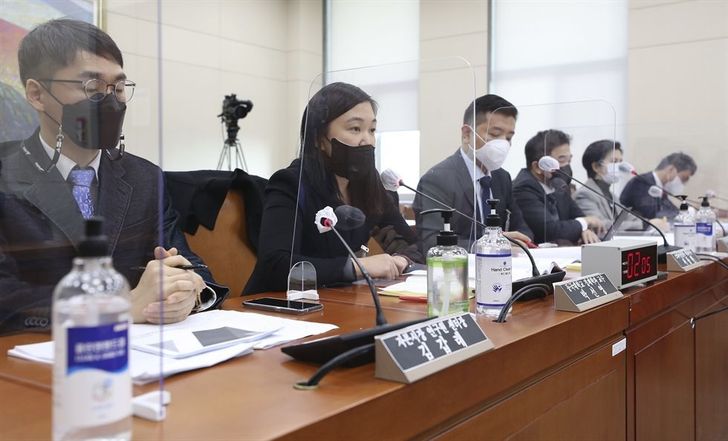
Dongguk University economics professor Park Sun-young, second from left, speaks during the National Policy Committee's public hearing on the legislation on virtual assets at the National Assembly in Seoul, Tuesday. Yonhap
By Park Jae-hyuk
Concerns remain over side effects of legislation on virtual assets
By Park Jae-hyuk
The Ministry of Economy and Finance's plan to tax gains from cryptocurrency trading starting next year is losing ground as more industry experts are backing the ruling Democratic Party of Korea's (DPK) idea of delaying the taxation to 2023.
At a National Assembly National Policy Committee public hearing on the legislation on virtual assets, Tuesday, none of five experts raised their hand when DPK lawmaker Kim Byung-wook asked them if there is anyone who objects to the delay of the taxation.
“If the government wants to impose taxes on certain incomes and use the money, it must ensure the safety of transactions causing those incomes and protect the property rights of taxpayers,” Korea Capital Market Institute's financial consumer protection research center head Kim Kab-lae said.
Including presidential candidate Lee Jae-myung, the ruling party has argued that the taxation on gains from cryptocurrency trading should be delayed to 2023, citing the government's insufficient infrastructure.
“It is difficult to justify the hastened taxation without enough preparation,” Lee wrote on Facebook earlier this month. “It will cause tax resistance and confusion.”
The main opposition People Power Party (PPP) has also agreed with the ruling party's claim, as its presidential candidate Yoon Seok-youl expressed his skepticism earlier about imposing taxes on gains from cryptocurrency trading under the current system.
Amid Finance Minister Hong Nam-ki's firm stance on the necessity of imposing taxes as planned, only the minor opposition Justice Party criticized Lee for using this issue to win support from voters in their 20s and 30s.
“The taxation is reasonable as it complies with the principle of 'there is tax, where there is income,'” Justice Party lawmaker Bae Jin-gyo, who also attended Tuesday's public hearing, said.
The five experts, who participated in the public hearing, however, shared the view that systems should be reformed first, before imposing taxes.
gettyimagesbank
From that standpoint, some of them supported the legislation on virtual assets.
“Korea is the country that should establish laws to protect investors earlier than other countries, considering the size of virtual asset transactions and the proportion of investors,” Dongguk University economics professor Park Sun-young said.
She added that the forthcoming laws should force virtual asset issuers to disclose important information to investors to prevent the problems of asymmetric information.
Rep. Kim of the DPK, who proposed the legislation on virtual assets, agreed with her stance, saying the new regulations will also be able to solve the problems of Upbit's monopoly on the domestic cryptocurrency market.
Some experts, on the other hand, expressed concern about the possibility of hastened regulations having a negative impact on the domestic virtual asset industry.
“If comprehensive regulations are tightened, there could be risks of businesses leaving Korea,” lawyer Yoon Jong-soo from Lee & Ko law firm said.
Choi Hwa-in, an adviser to the Financial Supervisory Service on blockchain policies, suggested the establishment of a new supervisory institution that understands virtual asset technologies and their roles.
“If the current regulations are imposed on the industry, businesses will face severe setbacks in using their technologies,” she said.
PPP lawmaker Yu Eui-dong agreed that the legislation should not be hastened, so the lawmakers decided to hold another public hearing later this month.