`Real estate speculation not acceptable'
Finance minister nominee not considering raising comprehensive real estate tax
By Yoon Ja-young
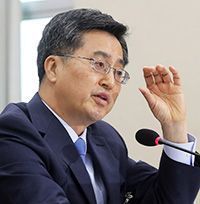
Finance minister nominee Kim Dong-yeon answers questions during his confirmation hearing at the National Assembly in Seoul, Wednesday. / Yonhap
Finance Minister nominee Kim Dong-yeon showed his determination to tackle speculative real estate investments that have heated up housing prices in and around Seoul.
“As the real estate market is showing signs of overheating especially in Seoul, we are closely monitoring it,” he said at a National Assembly confirmation hearing Wednesday.
Following President Moon Jae-in’s nomination of the former vice finance minister, lawmakers focused on examining his economic policy directions.
They asked him about his policies on mortgage regulations such as the loan-to-value and debt-to-income ratios, which determine the size of a mortgage a person can get according to housing value and income.
The former President Park Geun-hye administration eased the regulations to boost the housing market, but increasing calls say they should be tightened again amid its overheating and snowballing household debt.
Though he didn’t mention whether the loan regulations will be strengthened or not, Kim made it clear the government would show zero tolerance toward real estate speculation.
“Next week, the related ministries will start examining the market,” he said, hinting that the government will soon announce measures.
He said he is not considering raising the comprehensive real estate tax on housing, pointing out this was not included in presidential pledges.
Kim added that the government is preparing to levy taxes on the clergy next year. Currently, those engaged in religious services are exempt from paying income tax though some voluntarily file taxes. Despite growing demands for fair taxation, each administration has been cautious due to fear of losing votes from religious groups.
The minister nominee also said the taxation base should be broadened. Currently, nearly half of workers are exempt from earned income taxes.
Lawmakers also asked him about the Moon administration’s income-led growth strategy, which contrasts with past administrations’ export-led economic growth. “As there are many problems in domestic demand these days, income-led growth aims at boosting domestic demand. However, exports shouldn’t be overlooked,” he said, stressing balanced growth.
When a lawmaker wondered whether his philosophy fits with the welfare-focused Moon administration, Kim said he will consider fiscal conditions as well as a consensus reached at the National Assembly regarding social welfare spending. He pointed out that Kim had criticized some social welfare policies while serving as vice finance minister.
The minister nominee noted Korea faces huge challenges.
“While the per capita GDP has been stagnant at the $20,000 range for over 10 years, our growth potential has been weakening,” he said. “Jobs aren’t increasing despite economic growth and social and economic polarization is worsening. A low birthrate and the aging of society threaten the future.”
Kim stressed that “human” will be the focus of the economic growth policies, citing human-focused investment, economic fairness and innovative growth as three key policy goals.
“The economic policy will focus on job creation,” he said, adding that the government will lessen economic polarization by securing a social safety net while easing social mobility.
For a fair economy, he stressed a good incentive system which leads to fair compensation, as well as market order and better corporate governance structure that enable a healthy business ecosystem.
“We should tackle dualism in the labor market to get rid of unreasonable discrimination,” he said, pointing to the problem of irregular workers.