Catalyst for change in workplace culture?
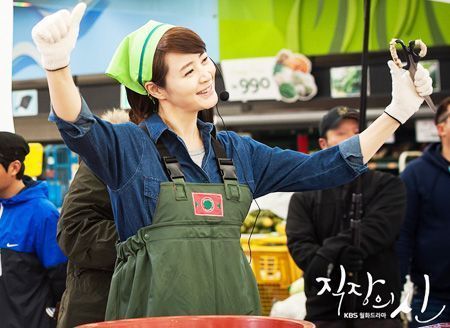
Miss Kim, the heroine of “Queen of the Office” performed by actress Kim Hye-soo, wows her colleagues with flashy crab-marinating techniques in the third episode of the soap opera.
‘Queen of Office,’ ‘Misaeng’ and ‘Infinite Company’ portray absurdity and injustice in office
By Kim Da-ye
Jeong Jun-ha, who performed as an incompetent manager in “Infinite Company,” leaves the company with his belongings after he was laid off.
Kim, an assistant manager in Misaeng, reprimands Jang Geu-rae, the hero of the popular comic strip who starts at a trading company as an intern.
Korea’s rigid — and often unfair — working environment is as old as the nation’s modern corporations, but it has only recently become a subject for scrutiny in popular culture.
“The Queen of Office,” a Korean version of Japanese TV drama “Haken no Hinkaku,” satirizes discrimination against contract workers. “Misaeng,” a strip cartoon published on web portal Daum, portrays in detail the hierarchy and politics in a large corporation. “Infinite Company,” an episode of entertainment program Infinite Challenge aired on April 27, stirred sympathy toward salaried workers when it dealt with the subject of corporate layoffs.
It’s no coincidence that the two TV programs and the online comic are aired and published at the same time and have gained immense popularity. The phenomenon reflects the transformation of the working environment or, at least, the perception of it.
“Korean society is in the middle of an enormous transition period. Young people do not stay in the same company for long because they cannot adjust to the working culture. It’s too authoritarian and hierarchical for them while it’s nothing strange for the older generation who started working in the 70s and 80s,” said Shin Kwang-young, a professor of sociology at Chung-Ang University, in a phone interview.
“Society is changing fast, but the working culture with its customs from the past has remained the same, causing problems.”
The professor added that the phenomenon is closely linked to the “democratization of the economy” — the country’s effort to move away from the concentration of wealth and power on a few toward justice and fair distribution of wealth. The democratization of the economy not only encompasses the treatment of subcontractors by large conglomerates and the gap between the rich and the poor but also covers the asymmetric power relationship between people within a company, he said.
The country is indeed in a period of transition. Since President Park Geun-hye was inaugurated and appealed to large corporations to share their earnings within society, a string of corporations have vowed to hire a large portion of contract workers as permanent employees. SK Group, for instance, announced on April 30 that its affiliates would permanently hire 5,800 temporary employees, mostly customer service advisors. E-mart, the country’s largest supermarket chain, has already changed the status of 9,100 workers taking care of shelves and 1,657 in fashion sales as permanent employees.
At the same time, the traditional power relationship between the superior “gab,” and the inferior “eul” is drawing unprecedented condemnation.
The story of a POSCO Energy executive who abused a Korean Air flight attendant caused much public anger, leading to the executive’s resignation and damage to the reputation of the whole POSCO group. A more recent example is retailers’ uprising against Namyang Dairy that allegedly asked distributors for kickbacks, were verbally abusive and supplied products that were close to their expiration dates. A recording of a Namyang Dairy manager verbally abusing a distributor circulated online, and dealt a huge blow to the firm’s reputation.
“The Queen of Office,” “Infinite Company” and “Misaeng” have so far served as cultural catharsis for Koreans.
In “the Queen of Office,” Jung Ju-ri, a clumsy, inexperienced temporary worker, is ruthlessly discriminated against while Miss Kim, the heroine of the drama and another temporary worker, outperforms permanent employees and coolly refuses to be hired permanently. The program scratches office workers where they itch by providing stories that they can sympathize with and enjoy a vicarious thrill from.
“Misaeng” is now a reference tool for salaried workers because it demonstrates the art of surviving the tough office life as a non-skilled, contract worker.
“The main character is a contract worker, a high-school graduate and a former baduk player,” said Kim, a 35-year-old fan of “Misaeng” who works at a nongovernmental organization in Seoul. “He enters a trading company full of college graduates. He grows in the company through learning how to handle relationships with colleagues rather than through skills or education.”
But absurdity and injustice within the workplace may do more than making people laugh and evoking their sympathy. Shim said that those cultural products can help change the society because they affect public opinion.
“They reflect change in the society while accelerating it. If they did not reflect the current society well, they wouldn’t have such high ratings. They make those problems public, and may possibly have a social and political impact,” said Shim, the professor at Chung-Ang University. “As long as politicians and the government listen to public opinion, they may take efforts to solve problems. In that sense, they are more than entertainment programs.”
The programs make public the absurdity and unfairness at work that would otherwise remain unknown and experienced only by office workers, although the light-hearted nature of the programs has been criticized by those who argue that the real-life working conditions for contract workers are much worse.
In the 12th episode of “the Queen of Office,” Jung Ju-ri came up with a good business idea but was told to submit under her boss’s name because she is just a temporary worker. It immediately became the subject of many entertainment news stories because viewers strongly sympathized with Jung’s situation.
In the 9th episode that also drew much attention from the entertainment media, a female temporary employee hid the fact that she was pregnant because she feared getting kicked out of the company. Under Korean labor law, contract workers do not enjoy the benefit of maternity leave, so they mostly quit their jobs before giving birth.
Kim, a fan of “Misaeng,” said, “The paradigm of the office has to change. The fatigue from the office culture of the industrial age has peaked. We need to work smart. Women should be able to take more holidays and even men should be able to take paternity leave. We should also be able to finish work on time and enjoy a different lifestyle outside work.”