'Get out of comfort zone'
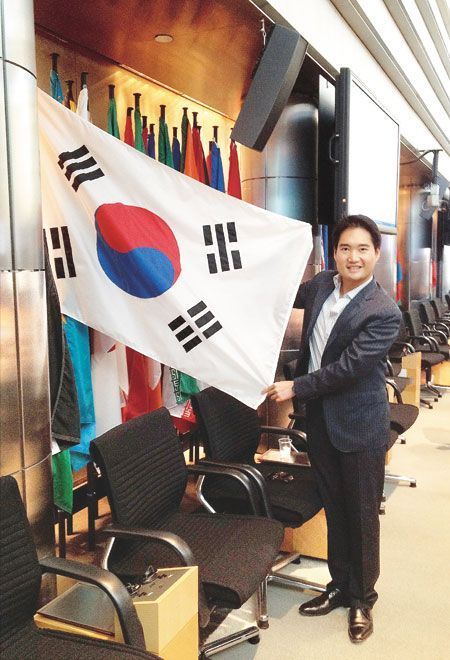
Ahn Chan-ho, an investment expert at the International Finance Corporation, poses with the Taegeukgi, Korea’s national flag, at the IFC headquarters in Washington D.C., Sept. 21, 2012. / Courtesy of Ahn Chan-ho
By Yoon Sung-won
Ahn Chan-ho, who graduated from Harvard Business School in May 2012, works for the International Finance Corporation (IFC), the private sector investment arm of the World Bank Group. As an investment manager, his job is to source, review, and recommend potential debt and equity investments for private companies in emerging economies.
His experience in finance and business management reaches even wider. Before Harvard, Ahn acquired an undergraduate degree in finance from the Wharton School of the University of Pennsylvania. After that, he worked at Bain and Company, in Singapore and San Francisco, for three years.
In an interview with The Korea Times’ Business Focus, Ahn gave details of how to effectively prepare an application for one of the world’s most sought-after U.S. business schools.
Q: Is there any specific reason why you chose Harvard Business School?
A:
Harvard is unique among business schools because almost all classes are taught using cases. I thought the exposure to the case method would serve as good contrast to my undergraduate background at Wharton, where the majority of the classes were lecture and assignment based.
I was also very impressed with the variety of career opportunities available at the business school — ranging from the traditional paths of corporate strategy and finance to rather untraditional options such as entrepreneurship and the public sector.
Q: How did you prepare for the application process to one of the top business schools in the world?
I prepared for the process with the following timeline. In May 2009, I started brainstorming ideas on what I wanted to write for the essay questions, and which referees would be able to strongly collaborate with what I wrote.
The next step was to do a crash course on the Graduate Management Admissions Test (GMAT) by taking as many GMAT sample exams as possible over a week. I took the exam immediately afterwards. And I had an outline for the essays by Sept. 2009.
Based on the outline, I chose three referees who would be able to tell a consistent story to the admissions board. I briefed them about what I was going to write, and why I chose them to be my referees. From this point onwards, I reminded them about the recommendation every two to three weeks to ensure they were on track to finish by early January.
Between October and December 2009, I finalized my essays with input from several friends who were either graduates of the business schools I was applying to, or were in the process of applying. By the end of December, I had close to 30 different updates on my essays. Interviews were done around February and March 2010, and the decisions were finally announced on April 2010.
Q: During the application process, which part do you think was the most important?
I think it’s writing a compelling set of application essays. It’s not because the essays matter the most in the eyes of the admissions board, but because they are the only things that are within your control.
While your academic and career profiles are important, they are already pre-determined by the time you apply and my recommendation would be to not stress over them during the process.
As to how to write compelling essays, I would suggest that you, first, understand why you want to go to business school, at this point of your career, and second, authentically tell your story based on that understanding.
Q: Is there any outstanding Harvard program you want to introduce?
Harvard Business School organizes an “Immersion Experience Program” for dozens of second-year MBA students during the winter break to visit a country outside the U.S., and do project work in areas of high priority for the country.
I went to Malaysia as part of the program, and met with the Malaysian Prime Minister Najib Razak. He was eager to learn more about our views on how Malaysia, a middle-income country that is “stuck in the middle,” could become a high-income country, and specifically cited Korea as a role model. It was great experience to engage with the prime minister, and have an impact as an MBA student.
Q: How did your experience at Harvard influence your career choice?
Having grown up in a developing country for much of my life, I have always been interested in international development. The International Finance Corporation is the world’s largest international development institution. So, for me, it was a no-brainer to sign with them when they offered me a job. HBS played an unexpectedly important role in this decision. The school constantly questions students to identify their passion and go for it. The two years at business school was a journey to find what I am passionate about. And I found my answer in international development.
Q: What were the career-related benefits of following an MBA course in more general terms?
At a very high level, I would say the school taught me, first, the confidence to know what I know, and ask for help when I do not know. Second, I learned the ability to think about others’ motivations before taking action and third, to aim for excellence but not perfection, and always remind myself that professional success is only a means to an end, and not the end itself.
Q: What would you advise for those who are considering applying to business school?
There are generally three reasons one goes to business school. They are academic — picking up skills that you did not have previously; career — switching to a different industry or accelerating your current position; and networking — getting to know different people and expanding your professional network.
The reason why you want to go likely will be a combination of all three. But different people have different weights for each, and so do the schools. Think about which schools provide the right combination, and focus on those instead of applying to schools that do not give you what you desire.
If the reason why you want to go to business school does not fall into any of the three, then perhaps you should re-explore your options or think more deeply about why you want to go.
For those who are heading to a business school next year, be very open. Harvard, or any other leading business schools, promises to be a transformative experience. But that can only be if you let the school change you. Get out of your comfort zone. Try things you would not have done otherwise. If you do, you will find yourself a different and better person than you were before business school.