Economics of eco-friendly vehicles
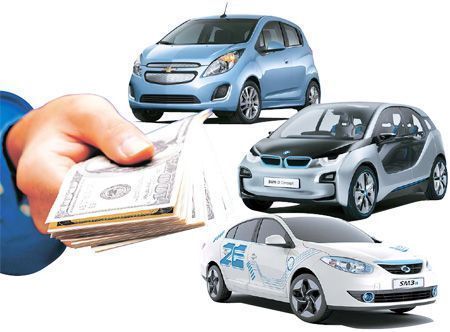
From top, GM Korea’s Chevrolet Spark EV, BMW i3 concept car and Renault Samsung Motors’ SM3 Z.E.
Money matters more than environment for motorists
By Kim Da-ye
Last year’s surge in demand for hybrid electric vehicles (EVs) suggests that consumers care more about value than the environment.
Price cuts, aggressive promotions by automotive makers and tax benefits for eco-friendly vehicles have made hybrid cars as competitive as their traditional counterparts in terms of price. This has led to significant increases in sales. For example, following temporary discounts, Hyundai Motor Company sold more Sonata Hybrids in Korea than in the U.S.
The domestic automotive industry will soon find out if the same principle applies to EVs, which are still not commercially available in Korea.
High prices and the lack of charging infrastructure have been blamed for the sluggish global sales of EVs. With General Motors Korea and Renault Samsung Motors planning to launch commercial EVs this autumn, the industry is paying close attention to the subsidies for EVs and their final price tags.
Behind hybrids’ popularity
In July last year, celebrating the first anniversary of the Sonata Hybrid, Hyundai offered a 2.5-million-won discount on the eco-friendly sedan, while guaranteeing key parts for 10 years and 200,000 kilometers, as well as offering a lifetime warranty for the battery.
The country’s largest automaker said at the time that the most expensive trim of the Sonata Hybrid, the Royal, became 100,000 won cheaper than its traditional counterpart with the same specifications. The price of the vehicle after discounts and tax exemptions was 31.2 million won.
The special promotion lasted until December, and sales numbers show it was an effective campaign. In December, 2,143 Sonata Hybrids were sold, compared to 7,505 traditional models. That’s a 213.8 percent increase from a year ago, and is significantly more than the 1,260 sold in the U.S.
Since January, the discount has shrunk to 1.5 million won, and the sales diminished to 1,053 in January and 910 in February.
The power of discount pricing is also proven by the hybrid models of the world’s largest car manufacturer, Toyota.
Toyota Motor Corporation and its affiliate Lexus together sold 15,700 cars last year, 6,000 of which were hybrid vehicles: 2,290 Toyota Priuses, 944 Lexus ES300hs and 1,824 Toyota Camry Hybrids, thanks to various subsidies and diversification of the models.
Take the case of Toyota Prius. When it was introduced in Korea in 2009, the full-option model was priced at 37.7 million won — too high a price tag for a compact-size hatchback. But in February last year, in an effort to reach more consumers, Toyota diversified the trims into three, according to an official at Toyota Korea.
The lowest trim, which did not have built-in navigation, was priced 31.3 million won. In the last few months, Toyota has been providing a fuel voucher worth 2 million won or an interest-free 24-month installment payment plan. That brings the price of the Prius below 30 million won, a highly attractive value for an imported car with high fuel efficiency.
2014, test years for EVs in Korea
Until 2011, EVs were the hottest products in the global market. GMs’ Chevrolet Volt was the North American Car of the Year at the North American International Auto Show in 2011. Nissan’s Leaf was named the European Car of the Year in the same year.
However, the enthusiasm for environment-friendly vehicles has dwindled. GM sold 23,461 Volts in 2012, more than three times as many as the 7,671 sold in 2011, but the figure is far below its target of 60,000. The sales of Nissan Leafs climbed to 9,800 in 2012, just 1.5 percent higher than in 2011.
The reason for the declining interest in EVs is economic. EVs are much more expensive than traditional models. The Chevrolet Volt, for instance, is priced at $39,145 in the U.S., and the federal government gives Volt buyers up to $7,500 in subsidies. For comparison, the similarly sized Chevy Cruze compact sedan starts at $17,130.
The EV also has to weather another hurdle that does not exist for hybrids — the lack of charging infrastructure. While hybrids need little government support and can be essentially handled by businesses themselves, EVs require close cooperation between the industry and the government.
Despite the dampened mood in the market, Pike Research, a research firm specializing in green energy, forecasts that the market will continue to grow and that annual worldwide sales of EVs, including hybrids, will reach 3.8 million by 2020.
“Sales of EVs have not lived up to automakers’ expectations and politicians’ proclamations, but the market is expanding steadily as fuel prices remain high and consumers increasingly seek alternatives to internal combustion engines,” Dave Hurst, Pike’s senior research analyst, said in a statement.
“Indeed, sales of plug-in EVs will grow at a compound annual rate of nearly 40 percent over the remainder of the decade, while the overall automarket will expand by only two percent a year.”
In Korea, the popularity of EVs has yet to be tested because they aren’t commercially available. The Kia Ray boxcars have been distributed to the public sector, including municipal governments, while Renault Samsung’s SM3 Z.E. compact sedans have been tested in the smart grid test bed in Jeju.
Beginning this autumn, various domestically developed EV models will be rolled out. GM Korea will begin producing the small Spark vehicle for the Korean market in September, and Renault Samsung plans to start mass-producing the Z.E. in October.
Kia Motors is preparing to launch the electric version of the mid-size Soul that can go 200 kilometers on a single charge. BMW will release the much-anticipated i3 compact EV in Korea in April next year.
Renault’s SM3 Z.E., currently priced at over 60 million won, is expected to be released at 45 million won, while both the GM Spark and Kia Ray will cost less than 40 million won. The BMW i3 is expected to be priced at over 50 million won.
The Ministry of Environment gave a subsidy worth 15 million won to the public-sector buyers of the Kia Rays, but hasn’t yet decided how much it will dole out to ordinary consumers.
Optimistic market observers hope that the price will come down to around 20 million won with various subsidies. For example, Jeju pledged earlier this year to provide a municipal subsidy of 8 million won in addition to 15 million won from the central government. The province also vowed to install slow chargers in locations chosen by the buyers of EVs.
Government’s role
Low prices alone cannot boost the EV market, which needs adequate charging infrastructure as well as public awareness in order to take off.
Last year, the Ministry of Knowledge Economy (now the Ministry of Trade, Industry and Energy) tested a car-sharing service, in which Kia Ray EVs were rented by the hour in busy areas in Seoul.
The test period ended in December last year, and the car-sharing service is now available to the public for 10,000 won per hour on weekdays and 6,000 won per hour on weekends. There are nine battery-recharging stations in Seoul and three in Gyeonggi Province.
The ministry is also operating a project to develop a compact-size EV with Hyundai Motor. The project will run until June next year, and the ministry has budgeted 11 billion won for it this year. Another project is developing mini EVs with price tags under 10 million won excluding batteries. Some 9 billion won will be injected into the project this year.
The question is whether the government will continue to foster the EV market after the existing projects have been completed.
Many of the EV projects that continue today were planned and executed by the Lee Myung-bak administration. The Park Geun-hye administration hasn’t yet shown an interest in EVs.
An official at the Ministry of Trade, Industry and Energy said policymakers are aware of the need to continuously invest in EVs until the market properly forms. The size of the government’s grant would have to remain similar to those of previous years, the official said.
“The industry is struggling more than expected, but foreign governments continue to work hard to foster the market. Other countries have done a lot, and Korea cannot reduce investment in EVs,” the official said.