Managers matter: closing gap on performance
Over the past 20 years, it has become pretty tough to be a manager. Middle management, in particular, has been greatly diminished by high-profile leaders or rock-star CEOs, who are accorded disproportionate credit compared to managers down the line for successful performances. Many organizations also have embraced some form of employee self-service as a way to streamline administrative processes, while electronic and social media led individuals to network with any other employee, the press, analysts, contacts in other organizations and directly with their own company’s executives. Who needs a manager in the middle?
On the surface, it appears that managers have been disintermediated — that their management role has become increasingly irrelevant in the face of leadership and technological forces. However, there is also growing recognition that frontline and middle managers still have a vital contribution to make. Findings from Towers Watson’s 2012 Global Workforce Study reinforce the view that the immediate manager has a strong influence on employees’ engagement with their work, attachment to their companies, and willingness to contribute discretionary effort to their company’s financial and operational success.
We use the term “sustainable engagement” to recognize the complex interplay of workforce engagement attitudes and behaviors revealed in our study. Sustainable engagement adds two important factors to mere willingness to go the extra mile. The first is enablement, which refers to the ability to excel because employees have the tools and resources they need to do their work without obstacles such as lack of information, unclear goals and organizational politics that reduce productivity. Second is energy, the capacity to maintain effort over time because people have interesting and challenging work, and a healthy environment in which to do their jobs.
Our research shows the clear value of achieving high sustainable engagement. Both productivity and retention metrics indicate that organizations with high levels of sustainable engagement have less absenteeism and lower presenteeism, or lost productivity at work, than those with high levels of disengagement. Organizations with high sustainable engagement also have less trouble retaining employees than those with disengaged workforces.
And when it comes to the bottom line, the numbers are equally impressive. Corporations with the highest level of sustainable engagement have average operating margins three times greater than organizations with the lowest engagement levels.
How do the most successful organizations build employee engagement and create the conditions that sustain it? Some steps must take place at the enterprise level, in which executive leaders lead the implementation of winning growth strategies and ensure that the organization conducts its business efficiently and with integrity and honesty.
But much of what increases and sustains employee engagement takes place at the local work-unit level. This is where goals are set; workload is managed, and individual contribution is linked to broader organizational performance. In other words, much of what matters, Towers Watson research shows, takes place in the domain of the frontline supervisor and middle manager.
Defining a great manager
According to Towers Watson research, the difference between average and great managers shows up in how they perform in five areas.
First is configuring work. Outstanding managers help employees craft jobs that have ample energizing elements such as interesting work and fulfilling team relationship, and the right level of challenge, neither too much nor too little, with the fewest possible performance obstacles — role ambiguity and organizational politics, for instance.
Second is delivering the deal. Top-performing managers draw from the spectrum of financial and nonfinancial rewards to sculpt an individualized deal with employees. They creatively use such elements as recognition, learning opportunities, project assignments and access to other leaders. Astute managers deliver to each employee a reciprocal social contract that responds to each individual’s needs and aspirations all within the bounds of the organization’s formal reward programs and policies. It’s the difference between merely administering the pay and benefit systems, and delivering a true employee value proposition.
Third is building trust. Strong managers hold themselves to a standard of acting and speaking that is higher than the minimum requirements imposed by the external world. Scholars of leadership call this authenticity. These elements form the basis for a trusting relationship between manager and employee.
Fourth is developing people. Good managers connect people with training, coach them and give frequent feedback. Great ones go further, helping employees create networks of internal and external learning contacts, and extending this constellation by making their own contacts available to trusted employees.
They work with each employee to craft an individual long-term plan for growth and advancement.
Last is energizing change. Effective managers envision, plan for and create the future. Sometimes, this requires responding to change that is imposed and unavoidable — reorganization, strategic redirection or downsizing, for example. In other cases, innovation and creativity may spark the change, as people develop new offerings or find better ways to work.
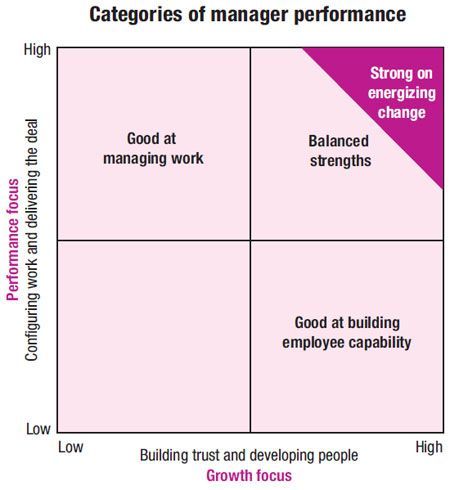
We have illustrated the relationships among these five manager performance elements in the graphic. The vertical axis represents the work configuration and deal delivery elements. We call them the manager’s performance focus. Employees will experience a manager who is strong on the performance elements as task-oriented — good at managing work and rewarding performance, but perhaps a little short on the relationship side of the job. The horizontal axis incorporates the trust-building and people development aspects of manager performance.
Together, these constitute a manager’s growth focus. A manager who excels at the requirements for employee growth may come across as an empathetic builder of employee performance capacity, but perhaps not as attentive to the immediate requirements for high productivity.
Managers who balance both these dimensions fall into the upper right-hand quadrant of the graphic. But those who also possess the competencies required to energize change effectively occupy the highest upper corner of that quadrant. These are the great managers whose people are productive, growing and creative. The departments led by those managers don’t just perform today’s work well. They also anticipate tomorrow’s work, and have the capabilities and resiliency to actually begin doing it. This is the true breeding ground of innovation and the manager’s best contribution to the competitive advantage of the organization.
One prize for increasing the overall effectiveness of the manager population, as we suggest above, is increased sustainable engagement. Our data also show that employees who work in the departments with higher-performing managers say they are more likely to stay with the organization even if offered a job elsewhere.
As the overall performance of manager populations improves from poor to good, the percentage of employees agreeing that they are sustainably engaged increases from 48 percent to 83 percent. The sustainable engagement percentage jumps another 9 percent as manager performance moves into the great category, where energizing change makes a real difference.
The same pattern exists with intent to stay with the organization: major improvement among good managers compared with poor ones, and an additional gain from moving to the great category.
Our conclusion is that aspiring to have a cadre of great supervisors and managers is a worthy goal, and organizations should commit to achieving it. But even upgrading a manager population from poor performance to reasonable strength on the growth and performance dimensions can yield substantial benefits to the organization and its employees.
Building manager capability
Systematically improving manager performance is not the intractable problem. But upgrading manager performance is both a full-scale organizational commitment and a one-manager at-a-time challenge. Fortunately, the evidence — both from intuition and data — shows that the returns on this investment are meaningful and real. The following are the advantages to be gained.
First is competitive superiority because your managers keep everyone relentlessly focused on doing work that achieves the organization’s vision for success.
Second is recruiting superiority because who wouldn’t want to come to your company, given its reputation as the place to work with, and become, a great manager.
Third is human capital superiority because better managers can help ensure your people have greater learning and growth opportunities than your competitors provide.
Fourth is workplace superiority because your managers create environments in which employees are not only more engaged and more capable than your competitors’ employees, but also better able to sustain high productivity and respond to change.
What should be done about managers?
Use employee survey data and other information such as performance ratings, full-circle feedback results and information from exit interviews, in order to identify the performance issues your managers might be facing.
Model the economics of manager positions — identify their greatest potential contribution to competitive advantage and define the role accordingly.
Use this role definition to design competencies, measurement systems and compensation plans.
Don’t assume that training alone will be sufficient to upgrade the manager population; consider as well how to improve processes for hiring, selecting and promoting manager candidates.
Anticipate the change management requirements associated with a large-scale upgrade of the roles and performance expectations of your manager population.
This article was provided by Towers Watson.