Diminishing chance of joining advanced nations
By Kim Min-jung
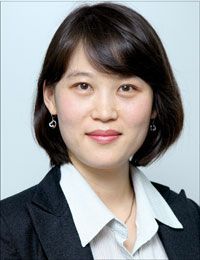
Kim Min-jung is a senior researcher at the Hyundai Research Institute.
The potential growth rate of the Korean economy which marked 6.5 percent in the 1990s has now dropped to around 3 percent and the nominal GDP per capita which recorded over $20,000 for the first time in 2007 has leveled out and remains largely the same.
There is now growing concern over the possibility of the Korean economy becoming trapped in the pit of the newly industrializing countries (NICS) as the gap between the real economic growth rate and the potential growth rate widens.
It is now critical to devise a strategy in order to achieve the objective of $40,000 by learning from other successful advanced countries.
There exist nine countries with a population of more than 10 million including the U.S., Japan and Germany which achieved $40,000 plus of GDP per capita. These countries can be classified into three different groups of advanced countries based on dependency on foreign trade.
The first group is “domestic consumption-oriented” advanced countries, such as the U.S., Japan, and Australia with less than 50 percent dependency on foreign trade.
The second group is “export-oriented” countries, such as the Netherlands and Belgium with 100 percent dependency on foreign trade.
The third comprises those countries where the domestic consumption and export are in balance, such as Germany, Sweden, France, and Canada with 50 to 100 percent dependency on foreign trade.
The degree of dependency on foreign trade can be drawn by dividing the sum of import and export amount by GDP.
It took these nine countries 9.6 years on average to reach $30,000 from $20,000, and another 5.6 years on average to reach $40,000, while Korea is still staying at not much higher than $20,000 as of 2012 since it reached $20,000 in 2007, showing little progress for the last six years.
These nine advanced countries shared seven traits in reaching GDP per capita of $40,000. First, the real GDP growth rate did not fall, but rose as the GDP increased from $30,000 to $40,000 unlike most other countries which experienced a declining growth rate as the size of the economy grew.
The growth rate when $20,000 climbed to $30,000 was 2.44 percent on average, whereas the growth rate was 2.48 percent on average for the period of increasing to $40,000 from $30,000. Second, fiscal sustainability improved.
The government debt ratio of seven countries except Japan and Belgium was 60 percent or more of GDP, and the scale of fiscal deficit was within 3 percent except Japan and the U.S.
Third, the current account which reflects international competitiveness maintained a good balance.
The current accounts of the seven countries except the U.S. and Australia were either in balance or in surplus.
Fourth, the service industry’s ratio of value added increased. The ratio was 68 percent for the period of reaching $30,000, and it gradually rose to 71 percent for the period of increasing to $40,000.
Fifth, the employment rate of the nine advanced countries reaching per capita GDP of $40,000 remained greater than 70 percent. Sixth, the aggregate birthrate of the nine countries maintained over 1.7 on average. Seventh, the transparency index was over 8.0, reflecting a high level of confidence and social capital.
We need to think about what Korea can learn from the seven shared traits of these successful countries. Korea, with its high dependency on foreign trade, should model itself on advanced countries with “domestic consumption and foreign trade in balance,” such as Germany and Sweden.
The prerequisites for $40,000 of GDP per capita are those measures needed to enhance growth potential and strengthen economic fundamentals such as fiscal sustainability and current account surplus.
The ratio of value added of the service industry should be extended to 70 percent from the current level of 58 percent by opening-up the service industry, relaxing regulations and strengthening a competitive edge.
The employment rate should be enhanced to 70 percent from the current rate of 64 percent through flexible labor market conditions and improving employment security networking.
The government should establish such policies whereby people can work and care for children at the same time as supporting the expansion of public nursery schools service and in-office facilities, and speeding-up the practice of paternity leave, which will eventually help enhance Korea’s current birth rate of 1.2 to 1.7, the average aggregate birth rate of those nine advanced countries. The transparency index should also be enhanced from the current 5.5 to over 8.0 through upgrading of e-government and disclosure of information.
If these requirements are met, the Korean economy would be able to leap to $40,000 and join the group of nine advanced countries. The outcome of whether Korea remains in the trap of NICS or jumps up to the level of $40,000 depends on how hard the 50 million Korean people work themselves towards that target.