Giving ingrained in Corporate America
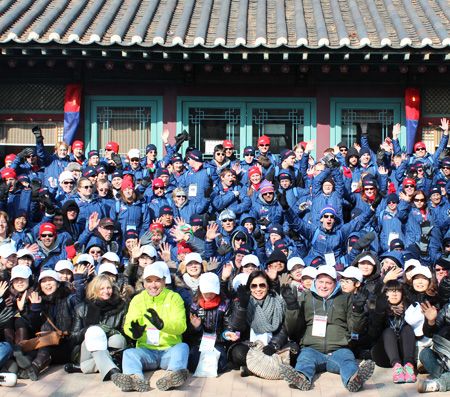
Volunteers from AMCHAM member companies pose with members of the Special Olympics Team USA at the Korean Folk Village in Yongin, Gyeonggi Province, on Jan. 27. AMCHAM supported a three-day host “town program” for the team to give the athletes a personal experience of Korean history, culture and food before competing in the 2013 Special Olympics World Winter Games in PyeongChang, Gangwon Province. / Courtesy of AMCHAM Korea
By Amy Jackson
Having lived in Korea for nearly four years, I have seen individual and corporate philanthropy (or “giving back to the society”) gaining momentum in this nation of “jeong.” Giving and sharing has always been an integral part of Korea’s way of life, and studies show individuals and corporations becoming more and more active in developing and participating in charitable giving.
As a nation, also, Korea recently came under the spotlight for becoming the first official aid recipient nation to become a donor nation. As corporate giving (now widely known as corporate social responsibility or CSR) takes root in Korea, I wanted to share how CSR has developed in the United States and how it has now become ingrained in the very DNA of “Corporate USA.”
Individual and corporate philanthropy in the United States have long been regarded as core social values: “Philanthropy is at the heart of who we [Americans] are as a society, and it is undeterred, if occasionally deferred, by hardship” (Giving USA 2011).
Studies show the U.S. is one of the leading nations in “per capita donations” and, according to Giving USA 2011, there has been an overall steadfast commitment to philanthropic giving in the United States for the past decade despite the personal and economic hardship brought about by the 2008 recession.
By taking a look at the history of giving, we are able to see how the practice of large-scale corporate philanthropy became rooted in America. It was motivated primarily by a few altruistic, well-known businessmen whose lives served as models for future generations.
John Rockefeller, Andrew Carnegie and Henry Ford were some of the first generation or founding fathers of large-scale corporate philanthropy in the United States. Their generous monetary contributions to society helped to enhance research, education, and social development during the late 1800s and early 1900s.
These traditions are carried on today. America has well-known figures like Warren Buffet and Bill Gates who are continuing the legacy of giving. Buffet, the third-richest person in the world as of 2011, has promised that 99 percent of his wealth will be donated for philanthropic purposes during his lifetime or at his death.
Bill Gates, the founder of Microsoft, is also renowned for his generous contributions to charities, such as those through the Bill and Melinda Foundation, the world’s largest private charitable foundation.
Gates has also encouraged fellow billionaires to participate in “The Giving Pledge” under which wealthy individuals pledge to give at least half of their assets to philanthropy. As of March 2013, 105 billionaires have signed the pledge, including Mark Zuckerberg and Dustin Moskovitz, the founders of Facebook.
These two young successful entrepreneurs have set a fine example for other wealthy Americans and corporations to continue this legacy of giving, as well as sending out a strong message for the rest of the world to see and follow.
With an established history, CSR has now become the norm in companies based in the U.S. and other wealthy countries. In fact, it has become a key component of many companies’ structures and core values.
The “philanthropic DNA” of American companies clearly extends to their business operations in Korea. Indeed, as we celebrate our 60th anniversary in Korea this year, the American Chamber of Commerce in Korea (AMCHAM Korea) and our member companies are truly proud of what we have been able to give back to Korean society since our establishment.
In the early years after the war, American companies such as General Electric and Standard Oil (now ExxonMobil) assisted Korea in its efforts to rebuild the nation’s infrastructure.
In the aftermath of the Asian financial crisis of 1997, AMCHAM established its charitable arm, the Partners for the Future Foundation, in order to help disadvantaged Korean families through scholarships for university students, vocational training programs, and related programs.
Since its establishment, the foundation has raised more than $12 million for scholarships, allowing nearly 2,000 Korean students to attend local universities. The foundation also collaborates with AMCHAM members to develop useful CSR events by combining its philanthropic expertise with companies’ resources.
Most of our member companies are also actively engaged in CSR activities in Korea. For example, Ford, under its vision of emphasizing the coexistence of humans and nature, awarded 53 projects and grants through the “Ford Motor Company Conservation & Environmental Grants” in Korea in 2002.
Another example is Microsoft Korea, which in 2012 partnered with the Ministry of Unification to narrow the opportunity gap for disadvantaged youth in Korea by providing PCs, peripherals and on-line educational programs to seven schools that specialize in assisting young North Korean defectors.
As one of AMCHAM’s key goals is to align its focus with that of our host nation, we gladly took up the opportunity to support the 2013 Special Olympics World Winter Games in PyeongChang.
In January of this year, AMCHAM and its members supported a three-day Host Town Program for the Special Olympics Team USA to give the athletes a personal experience of Korean history, culture and food before competing in the Games.
Job creation is another area of need in Korea (as in the U.S.), and we also contribute to this effort. Since our establishment six decades ago, our members have created tens of thousands of jobs. Further, many U.S. companies have internship programs for Korean students that give them invaluable hands-on experience on how multinational companies work, and help them hone their skills for future employment. To give more opportunities for students attending colleges outside of Seoul, AMCHAM is planning something new this year. We will be conducting one-day “Innovation Camps” where CEOs and staff from leading U.S. companies in Korea will meet with local students to provide career consulting and information about their internship opportunities and possible employment. We plan to have the first “Innovation Camp” on April 26th at Chungbuk National University.
?As Korea celebrates the inauguration of its first female president, AMCHAM is pleased that U.S. companies in Korea have played a key part in expanding employment opportunities for female white-collar employees. Even today, the ratio of women executives in U.S. companies in Korea is markedly higher than that in Korean companies. Current CEOs of several leading U.S. companies are very distinguished Korean female leaders. Further, U.S. companies have been eager to promote talented Koreans to regional and headquarter positions.
As we have seen, giving back to society has long been ingrained in the very DNA of American corporations, no matter where they are located. Over the last six decades, American companies have been proud and honored to have built lasting, mutually-beneficial partnerships with Korea’s consumers and companies, and we hope this meaningful relationship will continue, including our mutual efforts to serve the needs of the less privileged.